
UAE Transfer Pricing Safe Harbour
For Low Value-Adding Intra-Group Services — Understanding the 5% Mark-Up Rule Under UAE Corporate Tax Transfer Pricing Guidelines
1. Introduction
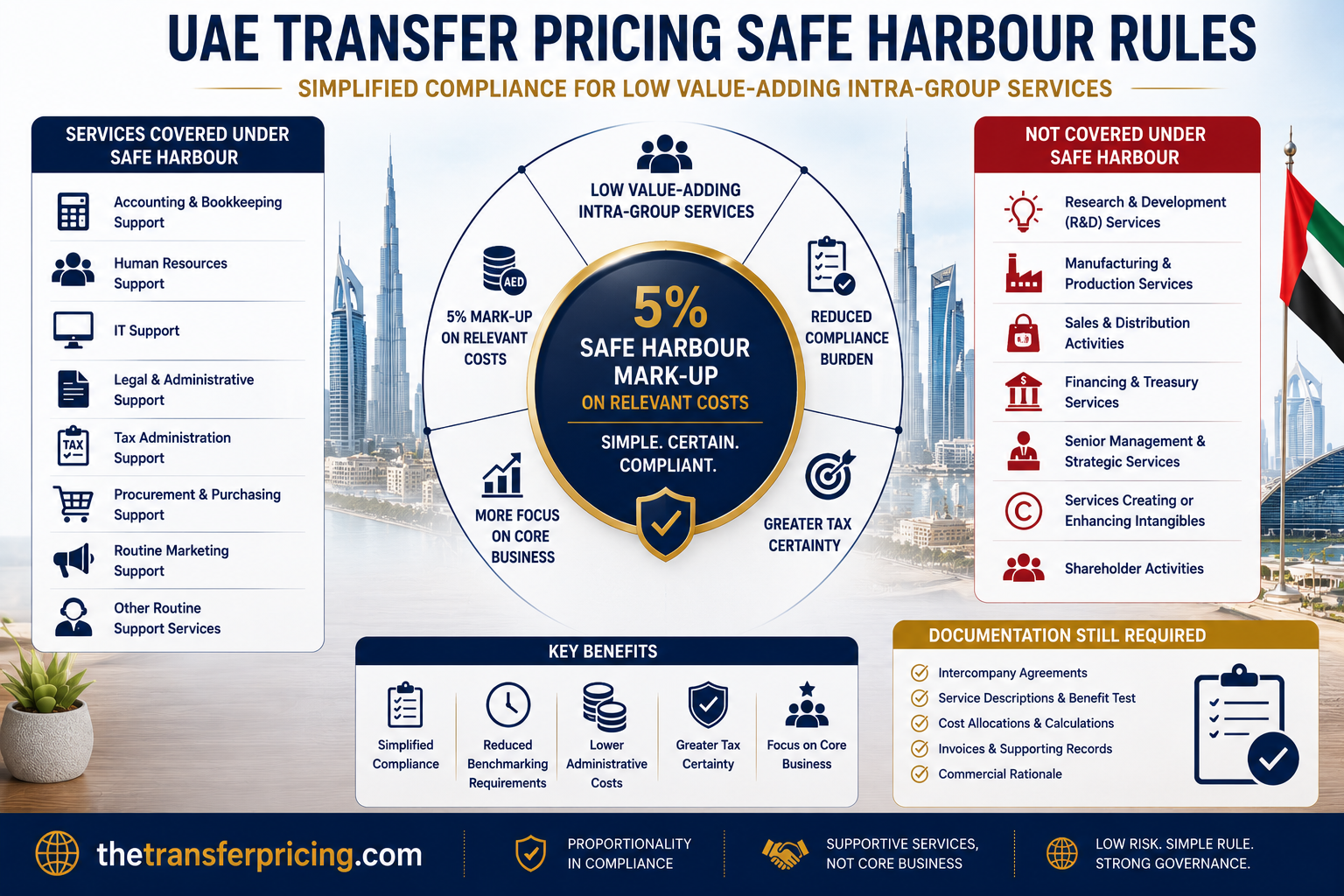
The UAE Transfer Pricing framework under the Corporate Tax regime introduced a simplified compliance mechanism for certain intra-group services commonly referred to as “Low Value-Adding Intra-Group Services”.
The purpose of this Safe Harbour rule is to:
- Simplify transfer pricing compliance
- Reduce benchmarking burden
- Lower administrative costs
- Provide certainty for routine support services provided within multinational groups
Under the UAE Federal Tax Authority (“FTA”) Transfer Pricing Guide (CTGTP1), qualifying low value-adding intra-group services may apply a Simplified 5% Mark-up on Relevant Costs without undertaking extensive benchmarking analysis.
This article explains what qualifies as low value-adding services, which services are excluded, the 5% mark-up mechanism, documentation expectations, and practical UAE transfer pricing considerations.
2. What Are Low Value-Adding Intra-Group Services?
Low value-adding intra-group services are routine support services performed within a group which:
- Are supportive in nature
- Do not form part of the core business
- Do not involve significant risks
- Do not create or enhance valuable intangibles
These services are generally administrative or auxiliary functions provided between related parties.
3. UAE Safe Harbour Mark-Up: 5%
The UAE TP Guide allows qualifying low value-adding services to apply a 5% Mark-up on Relevant Costs.
This means the service provider may charge its relevant cost base plus 5%, without requiring detailed benchmarking to justify the margin.
This is one of the most important practical simplification measures within UAE Transfer Pricing rules.
4. Why the UAE Introduced the 5% Safe Harbour
The FTA recognizes that routine intra-group support services generally carry low transfer pricing risk, do not involve significant value creation, and often create unnecessary compliance burden if full benchmarking is required.
The 5% approach therefore seeks to simplify compliance, reduce disputes, and align with internationally accepted OECD concepts.
5. Services Generally Covered Under UAE Safe Harbour
The UAE TP Guide indicates that qualifying low value-adding services may include routine support services such as:
5.1 Accounting and Auditing Support
- Bookkeeping support
- Accounting processing
- Internal accounting assistance
5.2 Human Resources Support
- Payroll administration
- Recruitment support
- Staff training coordination
- Personnel administration
5.3 Information Technology (IT) Support
- Routine IT maintenance
- Helpdesk support
- Software maintenance
- Network administration
5.4 Legal and Administrative Support
- Routine legal administration
- Document management
- Secretarial support
- Compliance coordination
5.5 Tax Administration Support
- Routine tax compliance support
- Tax filing coordination
- Tax administration assistance
5.6 Procurement and Purchasing Support
- Centralized purchasing support
- Supplier coordination
- Routine procurement administration
5.7 Marketing Support (Routine)
- Limited routine marketing coordination
- Administrative marketing support
- Non-strategic advertising support
6. Services NOT Covered Under UAE Safe Harbour
The FTA specifically excludes several categories from simplified Safe Harbour treatment. These exclusions are extremely important in practice.
7. Research and Development (R&D) Services
Services involving R&D, innovation, product development, or creation of intellectual property are NOT considered low value-adding services.
8. Manufacturing and Production Services
Core operational activities such as manufacturing, production, extraction, or processing activities are excluded from Safe Harbour treatment.
9. Sales and Distribution Activities
Core revenue-generating functions including sales, distribution, trading, and commercial negotiation are generally excluded.
10. Financial Transactions and Treasury Services
The following are generally NOT covered:
- Financing activities
- Treasury management
- Cash pooling
- Investment management
- Guarantee arrangements
- Insurance services
11. Senior Management and Strategic Services
Strategic and high-value functions are excluded, including:
- Senior management activities
- Strategic decision-making
- Business strategy formulation
- Entrepreneurial control functions
12. Services Creating Valuable Intangibles
Any service contributing to development of IP, enhancement of brands, proprietary technology, or unique know-how does not qualify for simplified treatment.
13. What Costs Can Be Included in the 5% Mark-Up?
The 5% mark-up generally applies on “Relevant Costs”. These commonly include:
- Direct service costs
- Employee costs
- Operational support costs
- Allocable indirect costs relating to the service activity
However, shareholder costs, duplicate costs, and non-beneficial costs should not be charged to recipients.
14. Key UAE Conditions for Applying the Safe Harbour
To apply the simplified 5% approach, the services generally should:
- Be supportive in nature
- Not constitute core business activity
- Not involve unique intangibles
- Not involve significant risks
- Provide economic benefit to recipients
15. Documentation Still Required
One of the most misunderstood areas is that Safe Harbour does NOT mean “no documentation”.
Businesses should still maintain:
- Intercompany agreements
- Service descriptions
- Allocation workings
- Cost calculations
- Invoices
- Evidence demonstrating benefit received
16. UAE Focus on “Benefit Test”
The FTA expects that intra-group services should provide Economic or Commercial Benefit.
The recipient should reasonably expect commercial value, operational support, or economic benefit from the service received.
17. Shareholder Activities Are NOT Chargeable
Activities performed solely because of ownership interest are generally Shareholder Activities and should not be charged to group entities. Examples may include:
- Shareholder reporting
- Investor relations
- Group restructuring solely for shareholders
- Parent company governance activities
18. Duplicate Services May Be Challenged
The FTA may challenge Duplicative Services where the recipient already performs the same activity internally or receives it elsewhere.
Businesses should therefore demonstrate genuine need, commercial benefit, and actual service receipt.
19. Why UAE Businesses Should Be Careful
Many businesses incorrectly assume all management fees qualify, all support services qualify, or 5% automatically applies.
In practice, classification errors, weak documentation, and strategic services incorrectly labeled as routine support may trigger transfer pricing adjustments.
20. Practical Example
Suppose a UAE group service center provides payroll support, bookkeeping support, and routine IT maintenance to related entities.
| Item | Amount |
|---|---|
| Relevant costs incurred | AED 1,000,000 |
| Permitted simplified mark-up | 5% |
| Arm’s Length Charge | AED 1,050,000 |
…without requiring extensive benchmarking studies.
21. Frequently Asked Questions (FAQs)
The UAE TP Guide permits a 5% mark-up on relevant costs for qualifying low value-adding intra-group services.
Only routine support-type management services may qualify. Strategic and high-value management functions generally do not qualify.
No. Treasury, financing, guarantee and investment-related activities are generally excluded.
Detailed benchmarking may not be required if qualifying conditions are satisfied.
Generally no. Shareholder activities should not normally be recharged to group companies.
No. R&D and intangible-related activities are specifically excluded.
No. Businesses still need supporting documentation and evidence.
22. Final Thoughts
The UAE Transfer Pricing Safe Harbour for low value-adding intra-group services provides an important simplification mechanism for routine support activities within multinational groups. The 5% mark-up on relevant costs significantly reduces compliance burden where qualifying conditions are satisfied.
However, businesses must carefully distinguish between routine support services, and strategic or high-value services, because incorrect classification remains one of the most common transfer pricing risk areas in practice.
Strong documentation, proper cost allocation, and accurate characterization remain essential even under simplified treatment.
23. Disclaimer
This article is intended for general informational purposes only and should not be considered legal, tax, or professional advice. UAE Corporate Tax laws, transfer pricing rules, and FTA guidance may evolve over time through legislative amendments, administrative practice, and regulatory interpretation.
Businesses should seek professional advice tailored to their specific facts and circumstances before applying Safe Harbour treatment or relying on simplified transfer pricing mechanisms.
24. How Prime Partners Global Can Assist
At Prime Partners Global, we assist businesses with practical UAE Transfer Pricing compliance solutions including:
- UAE Transfer Pricing Advisory
- Safe Harbour Eligibility Reviews
- Intercompany Service Charge Reviews
- Management Fee Assessments
- FAR Analysis
- Benchmarking Studies
- Master File & Local File Preparation
- Related Party & Connected Person Reviews
- UAE Corporate Tax Compliance Support
- Transfer Pricing Audit Readiness
To learn more, connect with us at Click Here.