
Determination of the Arm’s Length Price in Transfer Pricing
A Practical Guide to Arm’s Length Range, Comparability Analysis and Interquartile Range Under OECD Transfer Pricing Principles
1. Introduction
One of the most important and technically sensitive stages of transfer pricing analysis is the determination of the Arm’s Length Price (“ALP”) or arm’s length outcome. Under internationally accepted transfer pricing principles and the OECD Transfer Pricing Guidelines 2022, businesses are expected to establish pricing outcomes that reflect conditions which would have existed between independent enterprises under comparable circumstances.
In practice, determining the arm’s length price is rarely a simple mathematical exercise. Tax authorities globally increasingly focus on:
- Comparability quality
- Reliability of benchmarking
- Economic substance
- Consistency of data
- Statistical reliability of arm’s length results
Modern transfer pricing analysis therefore relies heavily on:
- Comparability analysis
- Benchmarking studies
- Financial indicators
- Arm’s length ranges such as the interquartile range
This article explains how tax authorities determine arm’s length outcomes, how interquartile ranges are calculated, and why concepts such as the lower quartile, median, and upper quartile are critical in modern transfer pricing practice.
2. What Is the Arm’s Length Price?
The Arm’s Length Price refers to the price, margin, or profit outcome that would have been agreed between independent enterprises dealing under comparable market conditions.
Depending on the transaction and transfer pricing method used, the arm’s length outcome may involve:
- A price
- A gross margin
- A net profit margin
- A mark-up
- A royalty rate
- Profit allocation
3. Why Determining the Arm’s Length Price Is Important
Tax authorities focus heavily on arm’s length pricing because Related Parties or Associated Enterprises may influence:
- Pricing
- Profitability
- Financing
- Risk allocation
- Commercial terms
Incorrect pricing may lead to:
- Profit shifting
- Tax adjustments
- Penalties
- Double taxation
- Transfer pricing disputes
As a result, determining a reliable arm’s length outcome is one of the core objectives of transfer pricing analysis.
4. OECD Principle: Comparability Is the Foundation of ALP Determination
The OECD Transfer Pricing Guidelines strongly emphasize that reliable arm’s length outcomes depend on “Comparability Analysis”. The goal is to compare controlled transactions with:
- Comparable uncontrolled transactions
- Comparable independent enterprises
The more reliable the comparability, the more reliable the arm’s length result.
5. What Is Comparability Analysis?
Comparability analysis is the process of evaluating whether differences between controlled transactions and uncontrolled transactions materially affect pricing or profitability.
The OECD Guidelines recognize that no two transactions are perfectly identical. Therefore, the objective is to identify sufficiently comparable arrangements capable of producing reliable results.
6. Key Comparability Factors Under OECD Principles
The OECD identifies several important comparability factors, discussed in the sections below.
7. Characteristics of Goods or Services
Authorities examine:
- Product quality
- Reliability
- Uniqueness
- Volume
- Contractual rights
- Service characteristics
Certain methods such as CUP require very high product comparability.
8. Functional Analysis (FAR Analysis)
Comparability analysis strongly depends on:
- Functions performed
- Assets used
- Risks assumed
The OECD emphasizes that comparables should have reasonably similar economic profiles.
9. Contractual Terms
Authorities review:
- Payment terms
- Warranties
- Responsibilities
- Pricing mechanisms
- Contractual rights
Different contractual terms may significantly affect pricing.
10. Economic Circumstances
Economic conditions are highly important. Authorities may evaluate:
- Geographic markets
- Industry conditions
- Competition
- Inflation
- Market maturity
- Economic cycles
Even similar transactions may produce different results under different market conditions.
11. Business Strategies
Comparability analysis may also consider:
- Market penetration strategies
- Innovation strategies
- Temporary loss-making positions
- Long-term investment approaches
The OECD recognizes that independent enterprises may adopt varying commercial strategies.
12. Internal Comparables vs External Comparables
Tax authorities generally prefer Internal Comparables — transactions conducted by the taxpayer with independent parties.
Where internal comparables are unavailable, businesses commonly rely on External Comparables, obtained through:
- Commercial databases
- Public financial information
- Benchmarking studies
13. Why Arm’s Length Results Often Produce a Range
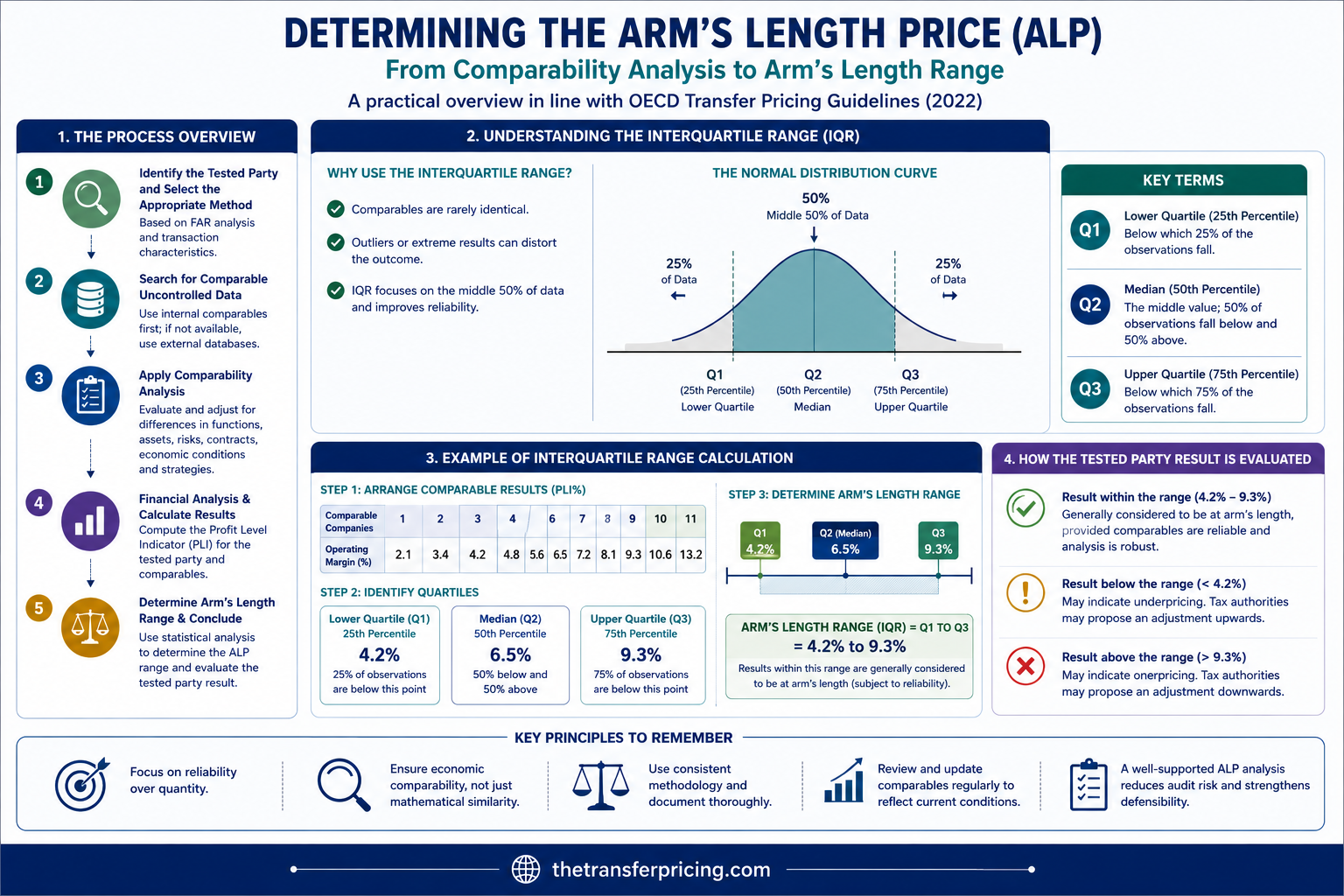
In practice, transfer pricing analysis often produces an Arm’s Length Range. This happens because:
- Comparables are not perfectly identical
- Market conditions vary
- Independent enterprises may earn different outcomes
The OECD recognizes that transfer pricing is not an exact science. Therefore, arm’s length analysis often results in a range of acceptable outcomes rather than a single figure.
14. Statistical Tools Used in Transfer Pricing
Modern transfer pricing benchmarking frequently uses statistical tools to improve reliability. The most commonly used approach globally is the Interquartile Range. This approach helps reduce the impact of:
- Extreme results
- Outliers
- Abnormal comparables
- Unreliable data points
15. Understanding the Interquartile Range (IQR)
The Interquartile Range is the statistical range between the lower quartile (25th percentile) and the upper quartile (75th percentile). It excludes extreme high and low observations.
The OECD recognizes the use of statistical tools such as the interquartile range where comparability defects remain and reliability can be improved.
16. What Is the Lower Quartile?
The Lower Quartile (“Q1”) represents the point below which 25% of observations fall. In transfer pricing benchmarking, it generally represents the lower boundary of the arm’s length range.
17. What Is the Median?
The Median (“Q2”) represents the middle value within the dataset. 50% of observations fall below the median, and 50% fall above it. The median is often considered a strong statistical indicator because it reduces the influence of extreme values.
18. What Is the Upper Quartile?
The Upper Quartile (“Q3”) represents the point below which 75% of observations fall. It generally forms the upper boundary of the arm’s length range.
19. Practical Example of Interquartile Range Calculation
Assume benchmarking produces the following margins:
| Comparable Companies | Margin |
|---|---|
| Company 1 | 2% |
| Company 2 | 4% |
| Company 3 | 5% |
| Company 4 | 7% |
| Company 5 | 9% |
| Company 6 | 11% |
| Company 7 | 14% |
After arranging the data from lowest to highest:
- Lower Quartile (Q1) may fall around 4%
- Median (Q2) may fall around 7%
- Upper Quartile (Q3) may fall around 11%
Arm’s Length Range = 4% to 11%
Results outside this range may attract transfer pricing scrutiny.
20. Why Tax Authorities Use the Interquartile Range
Tax authorities commonly apply the interquartile range because:
- Comparables are rarely perfect
- Financial data may contain distortions
- Extreme results may not reflect reliable arm’s length outcomes
The interquartile range improves statistical reliability, consistency, and defensibility of benchmarking studies.
21. What Happens If Results Fall Within the Arm’s Length Range?
Where the tested party result falls within the Arm’s Length Range, tax authorities generally consider the result acceptable, subject to:
- Reliability of comparables
- Quality of documentation
- Accuracy of the analysis
22. What Happens If Results Fall Outside the Arm’s Length Range?
Where the tested result falls outside the Arm’s Length Range, tax authorities may:
- Propose transfer pricing adjustments
- Question the comparability analysis
- Review the pricing methodology
In some jurisdictions, adjustments may move results toward the median, or another statistically appropriate point within the range.
23. Why Median Adjustments Are Common
The median is commonly used because:
- It represents the center of the arm’s length range
- Reduces impact of outliers
- Is viewed as statistically balanced
Many tax authorities prefer median adjustments during audits and disputes.
24. Reliability Is More Important Than Quantity
One of the key OECD principles is that “Reliability outweighs quantity”. A small set of highly reliable comparables may be preferable to a large dataset containing weak comparables. Authorities increasingly focus on:
- Quality of benchmarking
- Functional comparability
- Economic substance
25. Common Tax Authority Concerns During ALP Determination
Authorities commonly challenge:
- Weak benchmarking studies
- Inappropriate comparables
- Unsupported adjustments
- Inconsistent FAR analysis
- Cherry-picking comparables
- Poor documentation
The OECD strongly emphasizes consistency and objectivity.
26. Practical Challenges Businesses Commonly Face
Businesses often struggle with:
- Limited database access
- Inconsistent financial data
- Lack of reliable comparables
- Regional market differences
- Changing business models
This is especially common in emerging markets, niche industries, and highly specialized sectors.
27. Importance of Documentation
Businesses should maintain:
- Benchmarking studies
- Comparability analysis
- Financial calculations
- Database search strategies
- Rejection matrices
- Supporting economic analysis
Strong documentation significantly improves defensibility during audits.
28. Best Practices for Determining Arm’s Length Outcomes
28.1 Focus on Comparability Quality
Reliable comparables are more important than large datasets.
28.2 Align FAR Analysis With Benchmarking
Comparables should reflect similar functions, similar assets, and similar risks.
28.3 Apply Consistent Methodology
Consistency improves credibility and audit defensibility.
28.4 Review Benchmarking Periodically
Benchmarking studies should be updated regularly to reflect changing market conditions, business restructurings, and economic developments.
29. Frequently Asked Questions (FAQs)
It is the price, margin, or profit outcome that independent enterprises would have agreed under comparable market conditions.
Because comparable transactions are rarely identical, transfer pricing analysis often produces a range of acceptable arm’s length outcomes.
The interquartile range is the statistical range between the lower quartile (25th percentile) and upper quartile (75th percentile). It is used to improve reliability and reduce the impact of outliers.
The median represents the middle value within the benchmarking dataset.
Because the median reduces the influence of extreme results and represents the center of the arm’s length range.
Yes. Authorities may reject studies where comparables are weak, methodology lacks reliability, or documentation is insufficient.
Yes. External comparables are widely used where reliable internal comparables are unavailable.
30. Final Thoughts
Determination of the Arm’s Length Price is one of the most technically important aspects of transfer pricing compliance. Modern tax authorities increasingly focus on:
- Comparability quality
- Benchmarking reliability
- Economic substance
- Consistency of methodology
The use of statistical tools such as lower quartile, median, upper quartile, and interquartile range has become standard practice in transfer pricing benchmarking globally.
Businesses should therefore ensure that arm’s length analysis is economically supportable, statistically reliable, properly documented, and aligned with actual business conduct and value creation.
31. Disclaimer
The information contained in this article is intended for general informational and educational purposes only and should not be considered legal, tax, accounting, or professional advice. OECD Guidelines and domestic transfer pricing laws may differ between jurisdictions and may evolve over time through legislative amendments, administrative practice, and judicial interpretation.
While every effort has been made to ensure the accuracy and reliability of the information presented, no representation or warranty is made regarding its completeness, accuracy, or applicability to any particular situation. Businesses should seek professional advice tailored to their specific facts and jurisdictions before making transfer pricing decisions.
Reliance on this article without obtaining appropriate professional consultation may expose businesses to tax, compliance, or regulatory risks.
32. How Prime Partners Global Can Assist With Transfer Pricing
At Prime Partners Global, we assist businesses in navigating complex transfer pricing requirements through practical, technically robust, and commercially focused solutions aligned with OECD and international transfer pricing principles.
Our services include:
- Benchmarking Studies
- Comparability Analysis
- FAR (Functions, Assets & Risks) Analysis
- Interquartile Range Analysis
- Transfer Pricing Documentation
- Transfer Pricing Method Selection
- Economic Analysis
- Cross-border Tax Advisory
- Audit Readiness Support
- OECD-Aligned Transfer Pricing Advisory
We support:
- multinational groups,
- family businesses,
- SMEs,
- startups,
- investment structures,
- and expanding enterprises operating across multiple jurisdictions.
To learn more about our transfer pricing advisory services, connect with us at
At Prime Partners Global, we assist businesses in navigating complex transfer pricing requirements through practical, technically robust, and commercially focused solutions aligned with OECD and international transfer pricing principles.
Our services include:
- Benchmarking Studies
- Comparability Analysis
- FAR (Functions, Assets & Risks) Analysis
- Interquartile Range Analysis
- Transfer Pricing Documentation
- Transfer Pricing Method Selection
- Economic Analysis
- Cross-border Tax Advisory
- Audit Readiness Support
- OECD-Aligned Transfer Pricing Advisory
We support:
- multinational groups,
- family businesses,
- SMEs,
- startups,
- investment structures,
- and expanding enterprises operating across multiple jurisdictions.
To learn more about our transfer pricing advisory services, connect with us at Click Here.