
OECD Transfer Pricing Documentation: A Practical Guide to Master File, Local File and Country-by-Country Reporting
Understanding Global Transfer Pricing Documentation Requirements Under OECD Transfer Pricing Guidelines 2022
1. Introduction
Transfer pricing documentation has become one of the most important compliance and risk management areas for multinational enterprises (“MNEs”) operating internationally. Over the last decade, tax authorities globally have significantly increased their focus on:
- Transparency
- Transfer pricing documentation
- Economic substance
- Cross-border information exchange
- Profit allocation
The OECD Transfer Pricing Guidelines 2022, together with the OECD Base Erosion and Profit Shifting (“BEPS”) initiatives, introduced a globally recognized framework for transfer pricing documentation designed to:
- Improve transparency
- Enhance tax authority access to information
- Reduce information asymmetry
- Support transfer pricing risk assessment
Today, many jurisdictions worldwide have adopted documentation frameworks broadly aligned with OECD principles, particularly Master File, Local File, and Country-by-Country Reporting (“CbCR”).
This article explains the OECD transfer pricing documentation framework in a practical and easy-to-understand manner while highlighting important thresholds, timelines, reporting expectations, deadlines, and compliance risks.
2. Why Transfer Pricing Documentation Is Important
Transfer pricing documentation serves several important objectives.
From a tax authority perspective, documentation helps:
- Assess transfer pricing risk
- Evaluate compliance with the Arm’s Length Principle
- Identify potential profit shifting
- Facilitate audit selection
From a taxpayer perspective, strong documentation helps:
- Support pricing positions
- Reduce penalties
- Improve audit defensibility
- Demonstrate good faith compliance
The OECD strongly emphasizes that documentation should provide tax authorities with sufficient information to evaluate whether transfer pricing outcomes are arm’s length.
3. OECD Three-Tiered Documentation Framework
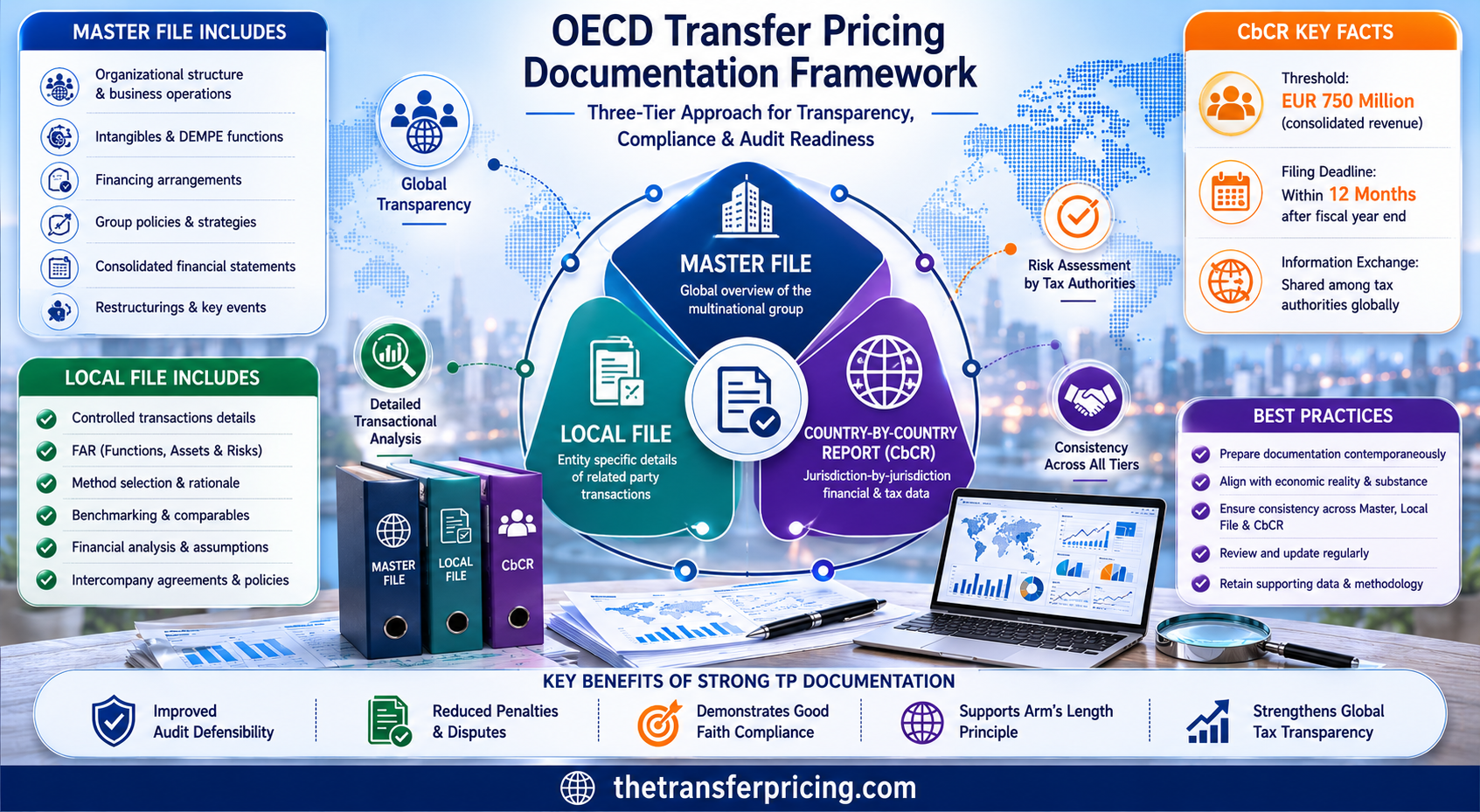
Under the OECD BEPS Action 13 framework, transfer pricing documentation generally consists of three key components:
- 3.1 Master File
- 3.2 Local File
- 3.3 Country-by-Country Report (“CbCR”)
This structure aims to provide global information, local transactional details, and jurisdictional profit allocation visibility.
4. Master File
4.1 What Is a Master File?
The Master File provides a high-level overview of the multinational group’s global business operations, organizational structure, intangibles, financing arrangements, and transfer pricing policies.
The objective is to provide tax authorities with an understanding of the overall MNE group, global value creation, and economic activities.
5. Information Typically Included in a Master File
The OECD recommends that a Master File generally include:
- Organizational structure
- Description of business operations
- Supply chain overview
- Important drivers of business profit
- Description of intangibles
- Intercompany financial activities
- Group financing arrangements
- Consolidated financial statements
- Transfer pricing policies
- Details of important business restructurings
6. Intangible Asset Information in the Master File
The OECD places significant emphasis on intangibles. The Master File may include information regarding:
- Ownership of intellectual property
- DEMPE functions
- R&D arrangements
- Licensing structures
- Intangible transfer arrangements
Tax authorities increasingly scrutinize intangible structures because they often drive significant profit allocation issues.
7. Financing Information in the Master File
The OECD also expects disclosure of:
- Intercompany financing arrangements
- Treasury functions
- Financing policies
- Significant financing transactions
This area has become increasingly important due to BEPS initiatives, interest deduction limitations, and financing-related transfer pricing scrutiny.
8. Local File
8.1 What Is a Local File?
The Local File contains detailed information relating to specific related party transactions undertaken by the local entity.
The Local File focuses on transactional analysis, benchmarking, FAR analysis, and application of the Arm’s Length Principle.
9. Information Typically Included in a Local File
The OECD recommends that a Local File generally include:
- Details of material related party transactions
- Description of controlled transactions
- Functional Analysis (FAR)
- Transfer pricing method selection
- Benchmarking studies
- Financial analysis
- Intercompany agreements
- Economic analysis
- Comparability analysis
- Assumptions used in pricing
10. Materiality and Thresholds
The OECD recognizes that Materiality Matters. Documentation requirements should generally focus on:
- Material transactions
- Economically significant arrangements
- Meaningful transfer pricing risk areas
However, materiality thresholds vary significantly between jurisdictions, and local legislation may impose different requirements. Businesses should therefore carefully review local country rules.
11. Country-by-Country Reporting (CbCR)
11.1 What Is CbCR?
Country-by-Country Reporting (“CbCR”) requires large multinational groups to provide tax authorities with jurisdiction-by-jurisdiction financial information, tax data, and business activity information.
The OECD introduced CbCR to improve global transparency and transfer pricing risk assessment.
12. OECD CbCR Revenue Threshold
Under OECD BEPS Action 13, CbCR generally applies where consolidated group revenue equals or exceeds EUR 750 Million during the preceding fiscal year.
This threshold has been widely adopted globally. However, local implementation rules may vary, and currency conversions may apply.
13. Information Included in CbCR
CbCR generally includes jurisdictional information such as:
- Revenue
- Profit or loss before tax
- Income tax paid
- Income tax accrued
- Stated capital
- Accumulated earnings
- Number of employees
- Tangible assets
- List of constituent entities
The objective is to provide tax authorities with a high-level overview of global profit allocation and economic activity.
14. OECD Focus on Risk Assessment
The OECD clarifies that CbCR is primarily intended for High-Level Transfer Pricing Risk Assessment. CbCR alone is generally not intended to directly determine transfer pricing adjustments, or replace detailed transfer pricing analysis.
However, authorities increasingly use CbCR data to identify audit targets, detect inconsistencies, and evaluate profit allocation patterns.
15. Timing and Filing Deadlines
Under OECD recommendations, CbCR is generally filed within 12 Months after the last day of the reporting fiscal year.
However, local filing deadlines vary by jurisdiction, and notification requirements may also apply.
16. Exchange of Information Between Tax Authorities
One of the key OECD objectives is International Information Exchange. Tax authorities increasingly exchange:
- CbCR reports
- Tax rulings
- Transfer pricing information
through international cooperation frameworks. As a result, inconsistencies are more easily detected, and cross-border transparency has significantly increased.
17. OECD Position on Documentation Timing
The OECD strongly encourages Contemporaneous Documentation. This means transfer pricing documentation should generally be prepared at or near the time transactions occur, not only after audits begin.
Contemporaneous documentation improves reliability, consistency, and audit defensibility.
18. Penalties and Documentation Risks
Many jurisdictions impose penalties where documentation is absent, incomplete, inaccurate, or not maintained timely.
Strong documentation may help reduce penalties, demonstrate good faith, and support reasonable compliance efforts.
19. OECD Emphasis on Proportionality
The OECD recognizes that documentation requirements should balance compliance burden and tax authority information needs. Smaller businesses may face disproportionate compliance costs if requirements become excessively burdensome.
As a result, some jurisdictions apply exemptions, thresholds, or simplified requirements for smaller taxpayers.
20. Functional Analysis and Documentation
The OECD strongly emphasizes that documentation should reflect actual conduct, operational reality, and economic substance. A strong FAR Analysis remains one of the most important components of transfer pricing documentation.
21. Tax Authorities’ Increasing Use of Data Analytics
Modern tax authorities increasingly use:
- Artificial intelligence
- Data analytics
- Risk scoring systems
- Automated information exchange
to assess transfer pricing risk. As a result, inconsistencies between documentation and actual results are more easily identified.
22. Common Documentation Mistakes
Businesses commonly face issues such as:
- Generic benchmarking studies
- Copy-paste documentation
- Weak FAR analysis
- Inconsistent financial data
- Outdated benchmarking
- Unsupported intercompany agreements
- Incomplete comparability analysis
- Failure to update documentation
- Inconsistency between CbCR and Local Files
These issues commonly trigger transfer pricing audits.
23. Documentation Retention and Updates
Businesses should regularly review documentation, update benchmarking, revise FAR analysis, and assess operational changes.
Documentation should evolve alongside business growth, restructurings, economic conditions, and regulatory developments.
24. Practical Best Practices for Businesses
24.1 Prepare Documentation Contemporaneously
Documentation should ideally be prepared during or shortly after the relevant financial year.
24.2 Align Documentation With Actual Conduct
Tax authorities increasingly compare reports, agreements, emails, financial data, and operational reality.
24.3 Maintain Consistency Across Reports
Consistency between Master File, Local File, CbCR, and financial statements is critically important.
24.4 Review Benchmarking Periodically
Benchmarking studies should be refreshed periodically to maintain reliability.
25. OECD Documentation and Audit Readiness
The OECD documentation framework is designed not only for compliance, but also for audit readiness, risk assessment, and dispute prevention.
Well-prepared documentation often significantly reduces audit exposure, disputes, and penalty risk.
26. Increasing Global Documentation Enforcement
Transfer pricing documentation requirements continue expanding globally due to:
- BEPS initiatives
- Transparency standards
- International cooperation
- Digital tax enforcement
Tax authorities increasingly expect high-quality documentation, commercial substance, and consistency across global filings.
27. Frequently Asked Questions (FAQs)
28. Final Thoughts
Transfer pricing documentation has become a central pillar of global tax compliance and international tax transparency. Modern tax authorities increasingly rely on:
- Master Files
- Local Files
- Country-by-Country Reports
- Data analytics
- Cross-border information exchange
to assess transfer pricing risk and evaluate multinational structures.
Businesses operating internationally should therefore approach transfer pricing documentation not merely as a compliance exercise, but as a strategic governance and risk management function supported by strong economic analysis, robust FAR analysis, reliable benchmarking, and alignment with commercial reality and value creation.
29. Disclaimer
The information contained in this article is intended for general informational and educational purposes only and should not be considered legal, tax, accounting, or professional advice. OECD Guidelines, BEPS initiatives, and domestic transfer pricing laws may differ between jurisdictions and may evolve over time through legislative amendments, administrative practice, and judicial interpretation.
While every effort has been made to ensure the accuracy and reliability of the information presented, no representation or warranty is made regarding its completeness, accuracy, or applicability to any particular situation. Businesses should seek professional advice tailored to their specific facts, transactions, and jurisdictions before making transfer pricing or documentation decisions.
Reliance on this article without obtaining appropriate professional consultation may expose businesses to tax, compliance, or regulatory risks.
30. How Prime Partners Global Can Assist With Transfer Pricing Documentation
At Prime Partners Global, we assist businesses in navigating complex transfer pricing compliance requirements through practical, technically robust, and commercially focused solutions aligned with OECD and international transfer pricing principles.
Our services include:
- Master File Preparation
- Local File Preparation
- Country-by-Country Reporting Support
- Benchmarking Studies
- FAR (Functions, Assets & Risks) Analysis
- Economic and Comparability Analysis
- Transfer Pricing Documentation Reviews
- Transfer Pricing Health Checks
- Audit Readiness Support
- OECD-Aligned Transfer Pricing Advisory
We support multinational groups, family businesses, SMEs, startups, investment structures, and expanding enterprises operating across multiple jurisdictions.
To learn more about our transfer pricing advisory services, connect with our team for a consultation at _______________.
30. How Prime Partners Global Can Assist With Transfer Pricing Documentation
At Prime Partners Global, we assist businesses in navigating complex transfer pricing compliance requirements through practical, technically robust, and commercially focused solutions aligned with OECD and international transfer pricing principles.
Our services include:
- Master File Preparation
- Local File Preparation
- Country-by-Country Reporting Support
- Benchmarking Studies
- FAR (Functions, Assets & Risks) Analysis
- Economic and Comparability Analysis
- Transfer Pricing Documentation Reviews
- Transfer Pricing Health Checks
- Audit Readiness Support
- OECD-Aligned Transfer Pricing Advisory
We support:
- multinational groups,
- family businesses,
- SMEs,
- startups,
- investment structures,
- and expanding enterprises operating across multiple jurisdictions.
To learn more about our transfer pricing advisory services, connect with our team for a consultation at Click Here.