
UAE Transfer Pricing: Related Parties and Connected Persons Under UAE Corporate Tax
Understanding Section 4.4.1 of the FTA Transfer Pricing Guide (CTGTP1 – October 2023)
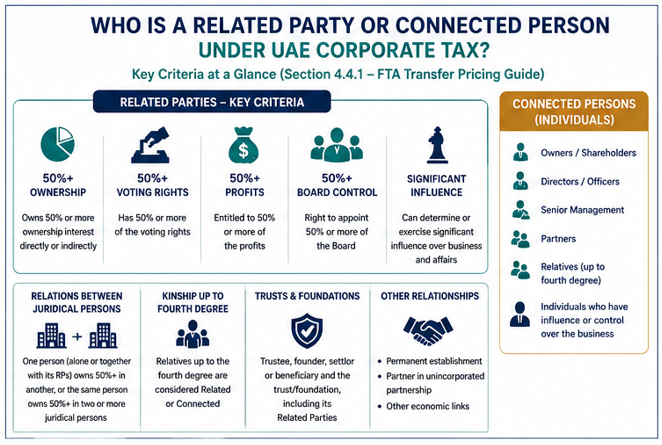
With the implementation of Corporate Tax in the UAE, businesses are increasingly required to understand how transfer pricing rules apply to their transactions and business structures. One of the most important concepts under the UAE transfer pricing framework is the identification of Related Parties and Connected Persons.
The UAE Federal Tax Authority (“FTA”) has provided guidance on this topic under Section 4.4.1 of the Transfer Pricing Guide (CTGTP1 issued in October 2023). These rules are highly important because transactions involving Related Parties and Connected Persons are subject to the Arm’s Length Principle and may attract scrutiny during a Corporate Tax review or audit.
This article explains the UAE position in a practical and easy-to-understand manner while covering the specific legal criteria and thresholds businesses should understand.
2. Why Related Parties and Connected Persons Matter in UAE Transfer Pricing
Under UAE Corporate Tax rules, transactions between Related Parties and Connected Persons must generally reflect market conditions similar to transactions between independent parties.
The FTA focuses on these relationships because connected entities or individuals may influence:
- pricing,
- profit allocation,
- financing arrangements,
- remuneration,
- management decisions,
- and commercial terms.
As a result, such transactions require proper commercial justification and supporting documentation.
3. Difference Between Related Parties and Connected Persons
Although these concepts are connected, they are not identical under UAE Corporate Tax law.
3.1 Related Parties
Related Parties generally include:
- entities,
- juridical persons,
- individuals,
- trusts,
- foundations,
- partnerships,
- and other arrangements
that have ownership, control, influence, or economic connection capable of affecting business decisions or transaction terms.
3.2 Connected Persons
Connected Persons generally refer to individuals connected to the business through:
- ownership,
- management,
- influence,
- or family relationship.
The Connected Person concept mainly focuses on payments or benefits provided to influential individuals connected with the business.
4. UAE Related Party Tests – Specific Criteria Under the FTA Guide
Under UAE Corporate Tax principles, a Person may generally be considered a Related Party where certain ownership, control, influence, or economic thresholds are met.
5. Ownership Interest Test (50% or More)
A Person may be considered a Related Party where that Person directly or indirectly owns:
- 50% or more ownership interest in another Person.
This includes:
- direct ownership,
- indirect ownership,
- or ownership together with Related Parties.
6. Voting Rights Test (50% or More)
A Related Party relationship may exist where a Person holds:
- 50% or more of the voting rights in another Person.
This test focuses on the ability to influence or control decision-making within the entity.
7. Profit Entitlement Test (50% or More)
A Related Party relationship may also arise where a Person is entitled to:
- 50% or more of the profits of another Person.
This applies even where ownership structures may appear different legally.
8. Board Control Test (50% or More)
A Person may qualify as a Related Party where that Person has the right to appoint:
- 50% or more of the Board of Directors of another Person.
This reflects the UAE focus on effective control and governance influence.
9. Significant Influence Test
Even where strict ownership percentages are not met, a Related Party relationship may still exist if:
- a Person can determine, or
- exercise significant influence over,
- the conduct of the business and affairs of another Person.
This is particularly important in:
- family businesses,
- informal business structures,
- management arrangements,
- and investment structures.
10. Related Parties Between Juridical Persons
Two or more juridical persons may be considered Related Parties where:
10.1 One Entity Owns Another
One juridical person, alone or together with its Related Parties, directly or indirectly owns:
- 50% or greater ownership interest in another juridical person.
10.2 Common Ownership Exists
Any Person, alone or together with Related Parties, directly or indirectly owns:
- 50% or greater ownership interest in two or more juridical persons.
This commonly applies to:
- group structures,
- holding companies,
- sister companies,
- and family-owned business groups.
11. Kinship and Family Relationship Rules (Up to Fourth Degree)
The UAE transfer pricing framework also recognizes family and kinship relationships. Related Party or Connected Person relationships may arise through relatives up to the fourth degree of kinship.
This may include:
- parents,
- children,
- grandparents,
- grandchildren,
- siblings,
- uncles,
- aunts,
- nephews,
- nieces,
- cousins,
- and extended family relationships depending on the degree of relation.
Family-owned businesses should therefore pay particular attention to transfer pricing compliance.
12. Connected Persons Under UAE Corporate Tax
Connected Persons generally include individuals connected with the business such as:
- owners,
- shareholders,
- directors,
- officers,
- partners,
- senior management,
- and their Related Parties.
The Connected Person concept is especially relevant where businesses make:
- payments,
- benefits,
- remuneration,
- or allocations
to influential individuals connected with the entity.
13. Common Connected Person Transactions Reviewed by the FTA
The FTA may review transactions such as:
- Director remuneration
- Shareholder salaries
- Consultancy fees
- Bonuses
- Rent paid to owners
- Interest on shareholder loans
- Personal expenses through company
- Management fees
- Expense reimbursements
The FTA may assess whether:
- genuine services were provided,
- the arrangement is commercially justifiable,
- and the pricing reflects arm’s length conditions.
14. Permanent Establishments and Unincorporated Partnerships
The UAE transfer pricing framework also covers relationships involving:
- Permanent Establishments (“PEs”)
- Partners in unincorporated partnerships
These relationships may create Related Party exposure depending on control, ownership, or economic linkage.
15. Trusts and Foundations
The UAE guidance also recognizes relationships involving:
- trustees,
- founders,
- settlors,
- beneficiaries,
- trusts,
- and foundations.
A Person connected with a trust or foundation and the trust’s or foundation’s Related Parties may fall within the Related Party framework.
16. Direct and Indirect Ownership Structures
The UAE rules consider:
- direct ownership,
- indirect ownership,
- and ownership aggregation through Related Parties.
This means businesses should carefully review:
- layered structures,
- nominee arrangements,
- holding entities,
- and indirect influence chains.
17. Economic Substance and Commercial Reality
One of the most important UAE transfer pricing principles is that the FTA evaluates:
- actual conduct,
- commercial substance,
- and economic reality
rather than relying solely on legal documentation. For example:
- labeling a payment as consultancy may not be sufficient,
- agreements without real services may be challenged,
- and excessive remuneration may attract scrutiny.
18. Common UAE Transfer Pricing Risk Areas
Businesses commonly face exposure in areas such as:
- Family-owned business groups
- Informal arrangements
- Unsupported consultancy fees
- Excessive shareholder remuneration
- Interest-free loans
- Lack of agreements
- Personal expenses charged to companies
- Unrecorded intercompany support
- Weak documentation
19. Documentation Expectations Under UAE Transfer Pricing Rules
Businesses should maintain documentation such as:
- Intercompany agreements
- Related Party registers
- Ownership structure charts
- Benchmarking studies
- Functional analysis
- Board approvals
- Service evidence
- Transfer pricing documentation
Strong documentation significantly reduces Corporate Tax risk.
20. Best Practices for UAE Businesses
The following practices help reduce transfer pricing risk for UAE businesses.
20.1 Identify Related Parties Early
Maintain clear records of:
- ownership,
- shareholders,
- directors,
- relatives,
- and connected entities.
20.2 Review Connected Person Payments
Ensure payments are:
- commercially reasonable,
- properly supported,
- and aligned with market conditions.
20.3 Conduct Periodic Transfer Pricing Reviews
Transfer pricing risks evolve as businesses:
- grow,
- restructure,
- or expand internationally.
Regular reviews are highly recommended.
21. Frequently Asked Questions (FAQs)
21.1 What is a Related Party under UAE Corporate Tax?
A Related Party generally refers to a Person or entity connected through ownership, control, influence, kinship, or economic relationship capable of affecting business decisions or transaction terms.
21.2 What is the ownership threshold for Related Parties in the UAE?
Generally, a threshold of 50% or more ownership, voting rights, profit entitlement, or Board control may create a Related Party relationship.
21.3 Does UAE transfer pricing apply to local UAE transactions?
Yes. UAE transfer pricing rules may apply to both domestic and cross-border transactions involving Related Parties or Connected Persons.
21.4 Are family businesses covered under UAE transfer pricing rules?
Yes. Family relationships up to the fourth degree of kinship may create Related Party or Connected Person exposure.
21.5 Can the FTA challenge excessive salaries paid to shareholders?
Yes. Payments to Connected Persons may be reviewed to determine whether they are commercially reasonable and at arm’s length.
21.6 Do trusts and foundations fall under UAE Related Party rules?
Yes. Trustees, founders, settlors, beneficiaries, trusts, foundations, and their Related Parties may fall within the UAE Related Party framework.
21.7 Does indirect ownership count under UAE transfer pricing rules?
Yes. The UAE framework considers both direct and indirect ownership structures.
22. Final Thoughts
The concepts of Related Parties and Connected Persons form one of the most important foundations of UAE Corporate Tax transfer pricing compliance. The UAE framework adopts a broad and substance-focused approach covering ownership, control, influence, kinship, trusts, partnerships, and indirect relationships.
Businesses operating in the UAE should carefully evaluate their structures, relationships, and transactions to ensure compliance with:
- the Arm’s Length Principle,
- documentation requirements,
- and broader Corporate Tax obligations.
Early identification and proper documentation of Related Party and Connected Person arrangements can significantly reduce future tax risk and FTA scrutiny.
23. Disclaimer
The information contained in this article is intended for general informational and educational purposes only and should not be considered legal, tax, accounting, or professional advice. UAE Corporate Tax laws, transfer pricing regulations, Cabinet Decisions, Ministerial Decisions, and FTA guidance may evolve over time.
While every effort has been made to ensure the accuracy and reliability of the information presented, no representation or warranty is made regarding its completeness, accuracy, or applicability to any particular situation. Businesses should seek professional advice tailored to their specific facts and circumstances before making decisions or implementing transfer pricing arrangements.
Reliance on this article without obtaining appropriate professional consultation may expose businesses to tax, compliance, or regulatory risks.
24. How Prime Partners Global Can Assist With UAE Transfer Pricing
At Prime Partners Global, we assist businesses in navigating UAE Corporate Tax transfer pricing requirements through practical, technically robust, and commercially focused solutions.
Our services include:
- Related Party and Connected Person Assessments
- Transfer Pricing Documentation
- Benchmarking Studies
- Intercompany Agreement Support
- Connected Person Remuneration Reviews
- Functional and Risk Analysis
- Transfer Pricing Health Checks
- Cross-border Tax Advisory
- Family Business Transfer Pricing Advisory
- FTA Audit Readiness Support
We work with:
- multinational groups,
- SMEs,
- startups,
- family businesses,
- investment structures,
- and expanding enterprises operating in the UAE.
To learn more about our UAE transfer pricing advisory services, connect with our team for a consultation at Click Here.