
Associated Enterprises, Related Parties and Connected Persons Explained
Understanding Associated Enterprises Under the OECD Transfer Pricing Guidelines (OECD 2022)
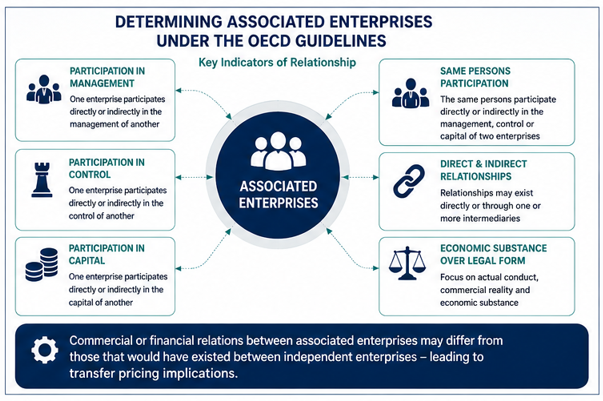
As transfer pricing regulations continue expanding globally, the concept of Associated Enterprises, commonly referred to as Related Parties, has become one of the most important foundations of international tax compliance.
The OECD Transfer Pricing Guidelines 2022 form the basis of transfer pricing frameworks adopted by many jurisdictions worldwide, including countries in Europe, the Middle East, Asia, Africa, and Latin America. The UAE Corporate Tax transfer pricing regime is also broadly aligned with OECD transfer pricing principles.
Understanding who qualifies as an Associated Enterprise or Related Party is critical because transfer pricing rules generally apply only where relationships exist that may influence commercial or financial conditions between parties.
This article explains the OECD approach to Associated Enterprises and related transfer pricing concepts in a practical and easy-to-understand manner for businesses, tax professionals, finance teams, and multinational groups.
2. What Are Associated Enterprises Under the OECD Transfer Pricing Guidelines?
Under the OECD framework, Associated Enterprises generally refer to enterprises where:
- one enterprise participates directly or indirectly in the management, control, or capital of another enterprise; or
- the same persons participate directly or indirectly in the management, control, or capital of two enterprises.
The OECD concept focuses primarily on:
- control,
- influence,
- management participation,
- and economic relationships.
The underlying concern is that connected parties may establish commercial or financial arrangements different from those that would have existed between independent enterprises.
3. Why the OECD Focuses on Associated Enterprises
The OECD transfer pricing framework is built around the Arm’s Length Principle, which requires Associated Enterprises to transact under conditions consistent with independent market behavior.
The OECD recognizes that Associated Enterprises may:
- influence pricing,
- shift profits,
- reallocate risks,
- structure financing artificially,
- or alter commercial terms.
As a result, transfer pricing rules are designed to ensure profits are aligned with economic activities and value creation.
4. OECD Criteria for Associated Enterprises
The OECD Guidelines intentionally adopt a broad and substance-focused approach. Relationships may arise through various forms of participation, influence, or control.
5. Participation in Management
Associated Enterprise relationships may exist where one enterprise participates directly or indirectly in the management of another enterprise.
Examples may include:
- overlapping directors,
- shared management teams,
- decision-making influence,
- strategic control,
- or operational direction.
The OECD focuses on actual influence rather than merely legal titles.
6. Participation in Control
An Associated Enterprise relationship may arise where one enterprise participates directly or indirectly in the control of another enterprise.
Control may exist through:
- voting power,
- contractual rights,
- governance arrangements,
- shareholder influence,
- or practical ability to influence business affairs.
The OECD does not prescribe a universal ownership percentage because countries may adopt different thresholds locally.
7. Participation in Capital
Associated Enterprises may also exist where one enterprise participates directly or indirectly in the capital of another enterprise.
This commonly includes:
- shareholding,
- equity participation,
- investment structures,
- and indirect ownership chains.
Many jurisdictions adopting OECD principles introduce specific thresholds such as:
- 25%,
- 50%,
- or effective control tests
depending on local tax legislation.
8. Common Control by the Same Persons
The OECD framework also covers situations where the same persons participate directly or indirectly in the management, control, or capital of two enterprises.
This commonly applies to:
- group companies,
- holding structures,
- multinational groups,
- family-controlled businesses,
- and common investment structures.
9. Direct and Indirect Relationships
The OECD Guidelines recognize both direct relationships, and indirect relationships. This means Associated Enterprise exposure may arise through:
- intermediary entities,
- layered holding structures,
- nominee arrangements,
- trusts,
- and indirect influence chains.
Tax authorities increasingly focus on beneficial ownership and actual economic influence.
10. Economic Substance Over Legal Form
One of the most important OECD transfer pricing principles is that tax authorities evaluate:
- economic substance,
- commercial reality,
- and actual conduct
rather than relying solely on legal documentation. For example:
- contractual terms may be disregarded if inconsistent with actual conduct,
- formal independence may not prevent Associated Enterprise status,
- and arrangements lacking commercial rationale may face scrutiny.
This principle strongly influences transfer pricing frameworks globally, including the UAE.
11. OECD Focus on Commercial and Financial Relations
The OECD Guidelines emphasize that transfer pricing analysis should consider whether commercial or financial relations between Associated Enterprises differ from those that would have existed between independent enterprises.
This includes review of:
- pricing,
- contractual arrangements,
- financing structures,
- service arrangements,
- risk allocation,
- and profit outcomes.
12. Family Relationships and Influence
Although the OECD Model primarily focuses on enterprises, many jurisdictions applying OECD principles expand the concept to include:
- family relationships,
- connected individuals,
- and economically linked persons.
Countries such as the UAE, KSA, and several European jurisdictions apply broader domestic Related Party rules influenced by OECD principles.
Family-owned businesses therefore commonly fall within transfer pricing frameworks.
13. Connected Persons Under Domestic Transfer Pricing Rules
While the OECD Guidelines primarily use the term “Associated Enterprises,” many jurisdictions separately introduce “Connected Person” concepts under domestic tax laws.
These commonly cover:
- shareholders,
- directors,
- officers,
- partners,
- relatives,
- and influential individuals connected with a business.
The UAE is one example where Connected Person provisions exist alongside Related Party rules.
14. Common Transactions Reviewed Under OECD-Based Transfer Pricing Frameworks
Tax authorities commonly review transactions involving Associated Enterprises such as:
- Sale and purchase of goods
- Management services
- Intercompany loans
- Royalty payments
- Licensing arrangements
- Cost-sharing agreements
- Shared service arrangements
- Distribution structures
- Procurement arrangements
- Business restructurings
The focus is whether such transactions reflect arm’s length conditions.
15. OECD Transfer Pricing and Multinational Groups
The OECD framework was primarily designed to address transfer pricing issues arising within multinational enterprise groups (“MNEs”).
This includes situations involving:
- cross-border transactions,
- profit allocation,
- intangibles,
- financing structures,
- and global value chains.
However, many countries now apply OECD-based transfer pricing principles to domestic related party transactions as well.
16. OECD Approach to Risk and Control
The OECD Guidelines place strong emphasis on:
- actual control over risks,
- decision-making authority,
- and financial capacity to bear risks.
Simply assigning risk contractually may not be sufficient. Enterprises claiming returns associated with risks should generally demonstrate:
- control over those risks,
- capability to manage them,
- and economic substance supporting the arrangement.
17. Common Risk Areas Under OECD-Based Transfer Pricing Systems
Businesses commonly face exposure in areas such as:
- Weak intercompany agreements
- Unsupported management fees
- Artificial financing arrangements
- Lack of benchmarking support
- Inconsistent group policies
- Substance deficiencies
- Excessive profit shifting
- Misaligned risk allocation
- Informal arrangements
18. Documentation Expectations Under OECD Principles
The OECD strongly emphasizes contemporaneous transfer pricing documentation. Businesses should generally maintain:
- Intercompany agreements
- Functional analysis
- Benchmarking studies
- Economic analysis
- Ownership structure charts
- Evidence of services
- Transfer pricing policies
- Financial support schedules
The OECD documentation framework also influenced: Master File, Local File, and Country-by-Country Reporting (“CbCR”) requirements adopted globally.
19. Relationship Between OECD Guidelines and UAE Transfer Pricing Rules
The UAE transfer pricing framework is broadly aligned with OECD transfer pricing principles. Concepts reflected within UAE Corporate Tax include:
- Arm’s Length Principle,
- Related Party rules,
- economic substance,
- transfer pricing documentation,
- benchmarking,
- and functional analysis.
However, businesses should remember that domestic UAE rules may contain additional or more specific requirements compared to the OECD framework.
20. Best Practices for Businesses Operating Under OECD-Based TP Frameworks
20.1 Maintain Clear Group Structure Documentation
Businesses should clearly document:
- ownership structures,
- control relationships,
- management links,
- and Associated Enterprise connections.
20.2 Align Agreements With Actual Conduct
Intercompany agreements should reflect:
- real operations,
- actual responsibilities,
- risk control,
- and commercial substance.
20.3 Conduct Periodic Transfer Pricing Reviews
Transfer pricing risks evolve continuously due to:
- business growth,
- restructurings,
- regulatory developments,
- and international tax reforms.
Regular reviews are highly recommended.
Frequently Asked Questions (FAQs)
What is an Associated Enterprise under the OECD Guidelines?
An Associated Enterprise generally refers to an enterprise participating directly or indirectly in the management, control, or capital of another enterprise, or where the same persons participate in multiple enterprises.
Does the OECD prescribe a fixed ownership percentage?
No. The OECD Guidelines themselves do not prescribe a universal ownership threshold. Individual countries may introduce their own thresholds within domestic legislation.
Are indirect ownership structures covered under OECD transfer pricing principles?
Yes. The OECD framework recognizes both direct and indirect relationships.
Do family businesses fall under OECD-based transfer pricing systems?
In many jurisdictions, yes. Domestic tax laws influenced by OECD principles often extend transfer pricing rules to family-controlled businesses and connected individuals.
What is the OECD Arm’s Length Principle?
The Arm’s Length Principle requires Associated Enterprises to transact under conditions similar to those that would exist between independent enterprises.
Why does the OECD focus on economic substance?
The OECD emphasizes economic substance to ensure profits align with actual business activities, risk control, and value creation rather than artificial legal structures.
Are OECD Guidelines legally binding?
The OECD Guidelines themselves are not law, but many countries adopt or align their transfer pricing legislation and administrative practices with OECD principles.
22. Final Thoughts
The OECD Transfer Pricing Guidelines 2022 establish the global foundation for understanding Associated Enterprises and transfer pricing compliance. The OECD approach focuses on management participation, control, capital relationships, economic substance, and commercial reality rather than relying solely on legal ownership structures.
As tax authorities globally continue strengthening transfer pricing enforcement, businesses should proactively identify Associated Enterprise relationships, maintain robust documentation, and ensure that transactions reflect arm’s length conditions supported by genuine commercial substance.
Understanding Associated Enterprise concepts is no longer relevant only for multinational tax teams — it has become a critical governance and risk management issue for businesses operating in today’s increasingly interconnected global economy.
23. Disclaimer
The information contained in this article is intended for general informational and educational purposes only and should not be considered legal, tax, accounting, or professional advice. OECD Guidelines, transfer pricing regulations, and domestic tax laws may differ between jurisdictions and evolve over time through legislative changes, judicial interpretation, and administrative practice.
While every effort has been made to ensure the accuracy and reliability of the information presented, no representation or warranty is made regarding its completeness, accuracy, or applicability to any particular situation. Businesses should seek professional advice tailored to their specific facts and operating jurisdictions before making decisions or implementing transfer pricing arrangements.
Reliance on this article without obtaining appropriate professional consultation may expose businesses to tax, compliance, or regulatory risks.
24. How Prime Partners Global Can Assist With Transfer Pricing
At Prime Partners Global, we assist businesses in navigating complex transfer pricing requirements through practical, technically robust, and commercially focused solutions aligned with OECD and UAE transfer pricing principles.
Our services include:
- Transfer Pricing Documentation
- OECD-Based Benchmarking Studies
- Functional and Risk Analysis
- Related Party and Associated Enterprise Assessments
- Intercompany Agreement Support
- Transfer Pricing Health Checks
- Cross-border Tax Advisory
- Business Restructuring Advisory
- Audit Readiness and Dispute Support
- UAE Corporate Tax Transfer Pricing Advisory
We support multinational groups, family businesses, startups, SMEs, investment structures, and expanding enterprises operating across multiple jurisdictions.
To learn more about our transfer pricing advisory services, connect with our team for a consultation at Click Here.