
Application of the Arm's Length Principle in Transfer Pricing
A Practical Guide to Applying the Arm’s Length Principle Based on OECD Transfer Pricing Guidelines 2022
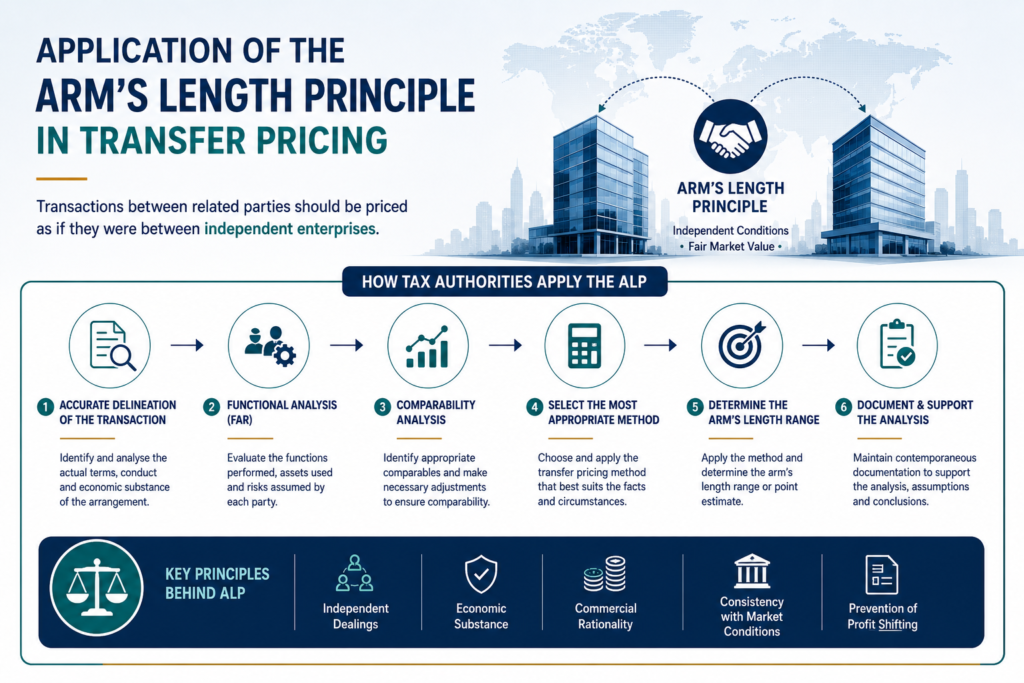
The Arm’s Length Principle (“ALP”) is the foundation of modern transfer pricing systems across the world. It is the internationally accepted standard used by tax authorities to determine whether transactions between Related Parties or Associated Enterprises reflect market conditions consistent with independent dealings.
Today, most transfer pricing frameworks globally — including those influenced by the OECD Transfer Pricing Guidelines 2022 — require businesses to apply the Arm’s Length Principle when pricing related party transactions.
However, applying the Arm’s Length Principle in practice is often far more complex than simply comparing prices. Tax authorities increasingly focus on:
- economic substance,
- actual conduct,
- commercial reality,
- risk allocation,
- and value creation.
This article explains how the Arm’s Length Principle is applied in practice based on globally accepted transfer pricing principles and OECD guidance.
2. What Is the Arm's Length Principle?
The Arm’s Length Principle requires transactions between Related Parties or Associated Enterprises to be priced as if the parties were independent enterprises dealing under comparable market conditions.
In simple terms: Related parties should not receive special pricing, benefits, or commercial conditions merely because they belong to the same group.
The objective is to ensure that taxable profits are aligned with:
- actual economic activities,
- functions performed,
- assets used,
- and risks assumed.
3. Why Tax Authorities Focus on the Arm's Length Principle
Tax authorities globally apply the Arm’s Length Principle to prevent:
- artificial profit shifting,
- base erosion,
- manipulation of intercompany pricing,
- and inappropriate allocation of profits across jurisdictions.
The principle seeks to ensure fairness and consistency in the allocation of profits among related entities. Authorities increasingly examine whether:
- pricing reflects commercial reality,
- risks are genuinely controlled,
- and transactions make economic sense.
4. The OECD Approach to Applying the Arm's Length Principle
The OECD Guidelines emphasize that transfer pricing analysis should not rely solely on contractual terms or accounting treatment.
Instead, the application of the Arm’s Length Principle requires a detailed understanding of:
- the transaction,
- the business model,
- the conduct of the parties,
- and the economic circumstances surrounding the arrangement.
The OECD approach is therefore heavily substance-driven.
5. Accurate Delineation of the Actual Transaction
One of the most important aspects of applying the Arm’s Length Principle is accurately identifying the actual transaction taking place.
Tax authorities evaluate:
- contractual arrangements,
- actual conduct,
- economic substance,
- decision-making,
- and commercial rationale.
This process is commonly referred to as: “Accurate Delineation of the Actual Transaction”
The OECD Guidelines make it clear that legal agreements alone are not sufficient if they do not reflect actual business conduct.
6. Key Factors Considered in Applying the Arm's Length Principle
The OECD framework identifies several important factors when analyzing related party transactions.
7. Contractual Terms
Authorities examine:
- agreements,
- pricing arrangements,
- payment terms,
- responsibilities,
- and rights and obligations of each party.
However, contracts are only one part of the analysis. Where actual conduct differs from written agreements, authorities may rely more heavily on actual behavior.
8. Functional Analysis
Functional analysis is one of the most critical aspects of transfer pricing. It evaluates:
- functions performed,
- assets used,
- and risks assumed by each party.
The OECD commonly refers to this as the: “Functions, Assets and Risks” (“FAR”) analysis.
Entities performing more complex functions and assuming greater risks would generally expect higher returns.
9. Characteristics of Property or Services
The nature of goods or services also affects arm’s length pricing. Authorities may evaluate:
- quality,
- reliability,
- volume,
- contractual protections,
- intellectual property,
- or uniqueness of products and services.
Small differences in characteristics may significantly affect pricing.
10. Economic Circumstances
The OECD Guidelines emphasize that pricing should be analyzed within the broader economic environment. This may include:
- geographic markets,
- industry conditions,
- competition,
- economic cycles,
- purchasing power,
- and regulatory environments.
Two similar transactions may therefore produce different arm’s length outcomes depending on economic circumstances.
11. Business Strategies
Transfer pricing analysis may also consider commercial strategies such as:
- market penetration,
- expansion plans,
- innovation strategies,
- long-term investments,
- or temporary loss-making arrangements.
Tax authorities may review whether such strategies are commercially reasonable and properly supported.
12. Commercial Rationality and Economic Substance
The OECD strongly emphasizes that transactions should have genuine commercial rationale and economic substance. Authorities may challenge arrangements where:
- transactions lack business purpose,
- risks are artificially allocated,
- or arrangements exist primarily to obtain tax benefits.
The OECD increasingly focuses on:
- substance over form,
- actual control,
- and value creation.
13. Risk Allocation Under the Arm's Length Principle
Risk allocation has become one of the most scrutinized areas in transfer pricing. The OECD requires that entities claiming returns associated with risks should:
- control those risks,
- have decision-making capability,
- and possess financial capacity to bear them.
Merely assigning risk contractually is generally insufficient.
14. Examples of Risks Commonly Reviewed
Authorities commonly review:
- market risk,
- inventory risk,
- product liability risk,
- foreign exchange risk,
- credit risk,
- operational risk,
- and strategic business risk.
The analysis focuses on who genuinely manages and controls those risks.
15. When Tax Authorities May Disregard Transactions
Under OECD guidance, tax authorities may disregard or recharacterize transactions in limited situations where:
- the arrangement lacks commercial rationality,
- economic substance is absent,
- or the transaction differs fundamentally from commercial reality.
However, the OECD also recognizes that such powers should be applied carefully and only in exceptional circumstances.
16. Comparability Analysis
Applying the Arm’s Length Principle requires comparison with independent transactions or enterprises. This process is called: “Comparability Analysis”
The objective is to identify:
- comparable uncontrolled transactions,
- or comparable independent companies.
Adjustments may sometimes be necessary to improve comparability.
17. Transfer Pricing Methods
Once the transaction is accurately delineated and comparability factors are analyzed, an appropriate transfer pricing method is selected. Common OECD-recognized methods include:
- Comparable Uncontrolled Price Method (“CUP”)
- Resale Price Method (“RPM”)
- Cost Plus Method (“CPM”)
- Transactional Net Margin Method (“TNMM”)
- Profit Split Method (“PSM”)
The most appropriate method depends on:
- transaction type,
- data availability,
- functional profile,
- and reliability of comparables.
18. Importance of Documentation
Tax authorities globally expect businesses to maintain robust transfer pricing documentation supporting:
- pricing methodology,
- benchmarking analysis,
- FAR analysis,
- commercial rationale,
- and intercompany arrangements.
Strong documentation significantly reduces:
- audit risk,
- disputes,
- penalties,
- and transfer pricing adjustments.
19. Common Transfer Pricing Risk Areas
Businesses commonly face transfer pricing exposure in areas such as:
- Unsupported management fees
- Artificial financing structures
- Weak intercompany agreements
- Misaligned profit allocation
- Excessive risk allocation
- Lack of substance
- Inconsistent documentation
- Intangible ownership structures
- Business restructurings
20. Best Practices for Applying the Arm's Length Principle
The following practices help businesses apply the Arm’s Length Principle effectively.
20.1 Align Transfer Pricing With Actual Operations
Transfer pricing policies should reflect:
- real business conduct,
- operational reality,
- and economic substance.
20.2 Maintain Strong Documentation
Businesses should maintain:
- agreements,
- benchmarking studies,
- functional analysis,
- and supporting evidence contemporaneously.
20.3 Review Transfer Pricing Regularly
Transfer pricing outcomes should be reviewed periodically due to:
- changing market conditions,
- restructurings,
- business growth,
- and regulatory developments.
21. Practical OECD Perspective on Arm's Length Pricing
The OECD recognizes that transfer pricing is not an exact science. Arm’s length outcomes often involve:
- judgment,
- economic interpretation,
- and reasonable approximation.
Tax authorities therefore focus on whether:
- the methodology is reasonable,
- the analysis is reliable,
- and the outcome reflects commercial reality.
22. Frequently Asked Questions (FAQs)
22.1 What is the Arm’s Length Principle in transfer pricing?
The Arm’s Length Principle requires Related Parties or Associated Enterprises to transact under conditions similar to those that would exist between independent enterprises.
22.2 Why is the Arm’s Length Principle important?
It helps ensure profits are aligned with economic activities and prevents artificial profit shifting between related entities.
22.3 What is accurate delineation of a transaction?
It refers to identifying the true commercial and economic nature of a transaction based on actual conduct, contractual terms, and economic substance.
22.4 Can tax authorities disregard intercompany agreements?
Yes. Authorities may rely on actual conduct and commercial reality where agreements do not reflect genuine business arrangements.
22.5 What is FAR analysis in transfer pricing?
FAR analysis refers to evaluating:
- Functions performed,
- Assets used,
- and Risks assumed
by each party in a related party transaction.
22.6 What transfer pricing methods are recognized by the OECD?
The OECD recognizes:
- CUP,
- RPM,
- CPM,
- TNMM,
- and PSM.
22.7 Can transfer pricing outcomes vary between countries?
Yes. While many countries follow OECD principles, domestic laws, local practices, and administrative interpretations may differ.
23. Final Thoughts
The application of the Arm’s Length Principle remains the cornerstone of global transfer pricing systems. Modern transfer pricing analysis goes far beyond pricing formulas and contractual language. Tax authorities increasingly focus on:
- economic substance,
- value creation,
- actual conduct,
- and commercial rationality.
Businesses operating internationally should ensure that related party transactions are:
- commercially justifiable,
- properly documented,
- economically supportable,
- and aligned with operational reality.
A proactive and well-supported transfer pricing framework significantly reduces audit exposure and strengthens long-term tax governance.
24. Disclaimer
The information contained in this article is intended for general informational and educational purposes only and should not be considered legal, tax, accounting, or professional advice. OECD Guidelines and domestic transfer pricing laws may differ between jurisdictions and may evolve over time through legislative amendments, administrative practice, and judicial interpretation.
While every effort has been made to ensure the accuracy and reliability of the information presented, no representation or warranty is made regarding its completeness, accuracy, or applicability to any particular situation. Businesses should seek professional advice tailored to their specific facts and jurisdictions before making transfer pricing decisions.
Reliance on this article without obtaining appropriate professional consultation may expose businesses to tax, compliance, or regulatory risks.
25. How Prime Partners Global Can Assist With Transfer Pricing
At Prime Partners Global, we assist businesses in navigating complex transfer pricing requirements through practical, technically robust, and commercially focused solutions aligned with OECD and international transfer pricing principles.
Our services include:
- Transfer Pricing Documentation
- Benchmarking Studies
- Functional and Risk Analysis
- Arm’s Length Pricing Reviews
- Intercompany Agreement Support
- Transfer Pricing Health Checks
- Cross-border Tax Advisory
- Business Restructuring Advisory
- Audit Readiness Support
- OECD-Aligned Transfer Pricing Advisory
We support:
- multinational groups,
- family businesses,
- SMEs,
- startups,
- investment structures,
- and expanding enterprises operating across multiple jurisdictions.
To learn more about our transfer pricing advisory services, connect with use at Click Here.