
OECD Transfer Pricing Dispute Resolution: Administrative Approaches to Avoiding and Resolving Transfer Pricing Disputes
A Practical Guide to Transfer Pricing Audits, MAP, APAs and International Tax Dispute Resolution Under OECD Transfer Pricing Guidelines 2022
1. Introduction
As transfer pricing regulations continue expanding globally, disputes between taxpayers and tax authorities have become increasingly common. Modern tax administrations are placing greater scrutiny on:
- Related party transactions
- Profit allocation
- Intercompany pricing
- Intangibles
- Financing structures
- Cross-border arrangements
As a result, businesses operating internationally are facing:
- Transfer pricing audits
- Adjustments
- Double taxation risks
- Lengthy disputes
- Increasing compliance burdens
Recognizing these challenges, the OECD Transfer Pricing Guidelines 2022 dedicate an entire chapter to “Administrative Approaches to Avoiding and Resolving Transfer Pricing Disputes”. The OECD strongly emphasizes that transfer pricing systems should not only ensure tax compliance but also provide mechanisms to:
- Prevent disputes
- Resolve disputes efficiently
- Reduce double taxation
- Improve certainty for taxpayers
This article explains the practical OECD approaches to avoiding and resolving transfer pricing disputes in a commercially understandable and globally relevant manner.
2. Why Transfer Pricing Disputes Arise
Transfer pricing disputes commonly arise because transfer pricing analysis involves:
- Economic interpretation
- Judgment
- Comparability analysis
- Valuation assumptions
- Subjective evaluation
Different tax authorities may interpret functions, risks, comparables, or pricing methodologies differently. As a result, the same transaction may produce competing tax positions across jurisdictions.
3. Common Causes of Transfer Pricing Disputes
Tax authorities commonly challenge:
- Weak benchmarking studies
- Inconsistent transfer pricing policies
- Unsupported management fees
- Financing arrangements
- Intangible ownership
- Business restructurings
- Low-profit entities
- Loss-making companies
- Substance deficiencies
Disputes are especially common where large cross-border payments exist, valuable intangibles are involved, or significant tax savings arise.
4. OECD Objective: Avoid Double Taxation
One of the key OECD objectives is “Avoidance of Double Taxation”. Double taxation may arise where one jurisdiction increases taxable profits, while another jurisdiction does not provide a corresponding adjustment. This can result in the same profits being taxed twice. The OECD therefore promotes administrative mechanisms to resolve such disputes efficiently.
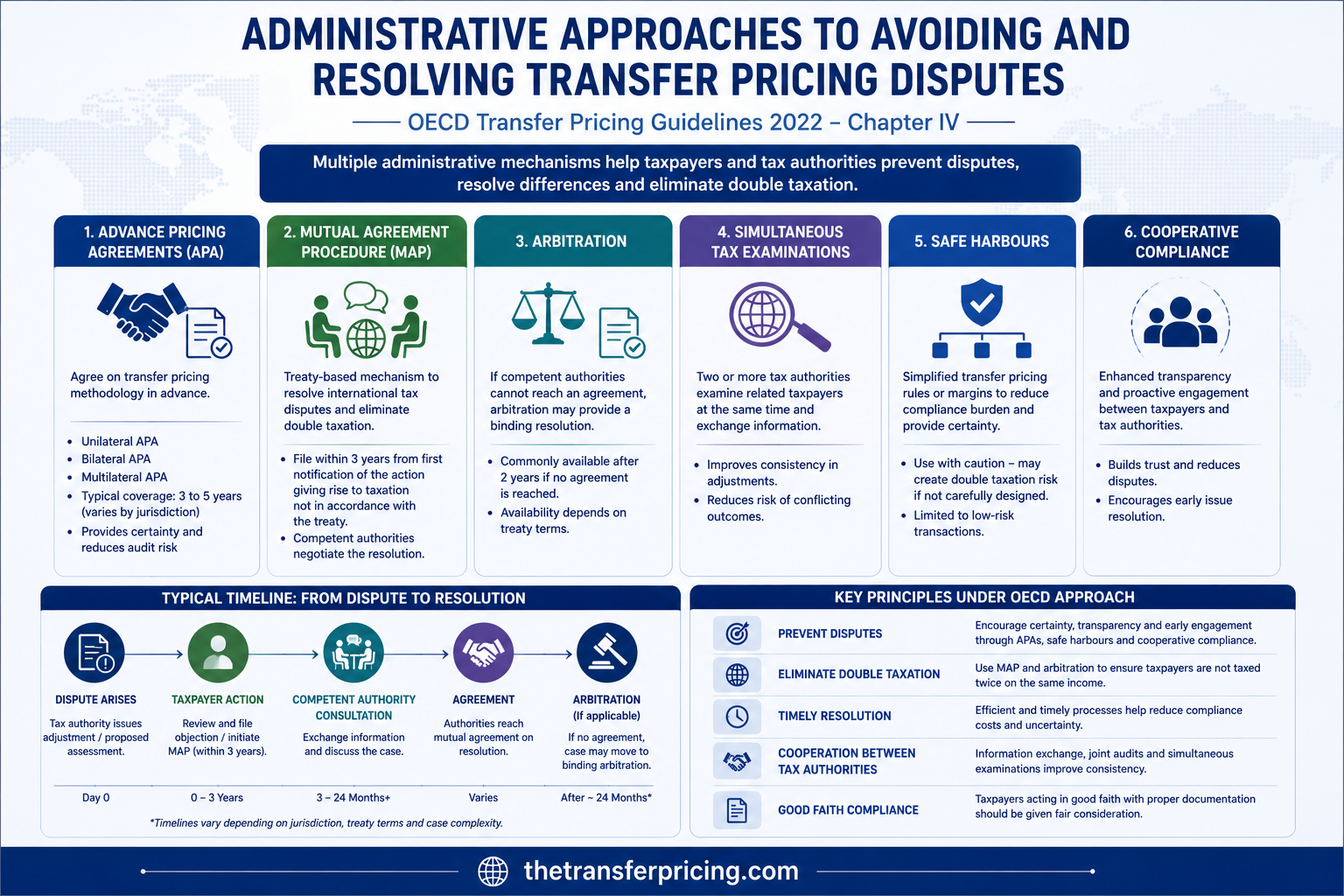
5. OECD Approaches to Avoiding and Resolving TP Disputes
The OECD Guidelines discuss several mechanisms designed to prevent disputes, reduce uncertainty, and resolve disputes where they arise. These mechanisms include:
- Advance Pricing Agreements (“APAs”)
- Mutual Agreement Procedures (“MAP”)
- Simultaneous Tax Examinations
- Safe Harbours
- Cooperative Compliance Programs
- Arbitration Mechanisms
6. Advance Pricing Agreements (APAs)
6.1 What Is an APA?
An Advance Pricing Agreement (“APA”) is an arrangement between taxpayers and one or more tax authorities that determines transfer pricing methodology in advance for future transactions. APAs are designed to provide:
- Certainty
- Predictability
- Reduced audit exposure
7. Types of APAs
The OECD recognizes three common types of APAs:
7.1 Unilateral APA
Agreement between taxpayer and one tax authority only.
7.2 Bilateral APA
Agreement involving taxpayer and tax authorities of two jurisdictions.
7.3 Multilateral APA
Agreement involving multiple tax authorities across several jurisdictions.
Bilateral and multilateral APAs are generally preferred because they reduce risks of double taxation.
8. Typical APA Coverage Periods
The OECD notes that APAs commonly apply for 3 to 5 years, although actual periods vary by jurisdiction. Some jurisdictions may also permit rollback provisions, allowing APA principles to apply to prior years under certain conditions.
9. Benefits of APAs
APAs may provide:
- Reduced litigation
- Lower audit risk
- Certainty in pricing
- Improved tax authority relationships
- Reduced compliance disputes
APAs are particularly useful for large multinational groups, complex transactions, and recurring intercompany arrangements.
10. Challenges and Costs of APAs
Despite benefits, APAs may involve:
- Lengthy negotiations
- Significant documentation
- Disclosure obligations
- Professional costs
- Substantial management involvement
In practice, APA processes may sometimes take several months, or multiple years, depending on complexity and jurisdiction.
11. Mutual Agreement Procedure (MAP)
11.1 What Is MAP?
The Mutual Agreement Procedure (“MAP”) is a treaty-based dispute resolution mechanism allowing tax authorities of two jurisdictions to negotiate resolution of international tax disputes. MAP is commonly used where transfer pricing adjustments result in:
- Double taxation
- Inconsistent tax treatment
- Competing jurisdictional claims
12. OECD Position on MAP Access
The OECD strongly encourages jurisdictions to provide effective, timely, and accessible MAP processes. Taxpayers should generally have access to MAP where treaty obligations apply.
13. MAP Filing Deadlines
Under many tax treaties influenced by the OECD Model Tax Convention, taxpayers generally must present MAP requests within Three Years from the first notification of the action giving rise to taxation not in accordance with the treaty. However, actual deadlines vary by treaty and jurisdiction, and local procedural rules may differ. Businesses should therefore review applicable treaty provisions carefully.
14. MAP Process in Practice
MAP typically involves:
- Taxpayer submission
- Review by competent authorities
- Negotiation between tax administrations
- Agreement on resolution
The taxpayer usually does not directly participate in negotiations between authorities.
15. OECD Focus on Timely Resolution
The OECD strongly emphasizes efficient dispute resolution. Many international initiatives now focus on reducing MAP inventories, improving processing times, and increasing cooperation between tax authorities. In practice, complex MAP cases may still take several years, particularly for large multinational disputes.
16. Arbitration Mechanisms
Some tax treaties include Mandatory Binding Arbitration where competent authorities cannot resolve disputes within specified periods. Under many OECD-based treaty provisions, arbitration may become available after Two Years if competent authorities fail to reach agreement. However, arbitration availability depends entirely on treaty wording, and many jurisdictions still do not apply mandatory arbitration.
17. Simultaneous Tax Examinations
The OECD also discusses Simultaneous Tax Examinations. These involve two or more tax authorities examining related taxpayers simultaneously while exchanging relevant information. The objective is to:
- Improve consistency
- Reduce duplication
- Prevent conflicting adjustments
18. Joint Audits
Some jurisdictions increasingly conduct Joint Transfer Pricing Audits where multiple tax authorities cooperate during the examination process. Joint audits may improve efficiency, reduce conflicting outcomes, and accelerate dispute resolution. However, they may also increase information requests, coordination burdens, and complexity for taxpayers.
19. Safe Harbours
19.1 What Are Safe Harbours?
Safe harbours simplify transfer pricing compliance by allowing taxpayers to apply predetermined margins, simplified methodologies, or simplified compliance rules. Where applicable, safe harbours may reduce compliance burdens, documentation requirements, and audit risks.
20. OECD Caution Regarding Safe Harbours
The OECD recognizes that poorly designed safe harbours may create double taxation risks, inappropriate pricing outcomes, or opportunities for tax planning. As a result, the OECD generally recommends careful and limited application of safe harbours.
21. Cooperative Compliance Programs
Many jurisdictions increasingly adopt Cooperative Compliance Models. These involve enhanced transparency, ongoing dialogue, and proactive communication between taxpayers and tax authorities. The OECD generally supports approaches encouraging early engagement, voluntary compliance, and dispute prevention.
22. Documentation as a Dispute Prevention Tool
The OECD strongly emphasizes that robust documentation significantly reduces transfer pricing disputes. Businesses should maintain:
- Benchmarking studies
- FAR analysis
- Intercompany agreements
- Economic analysis
- Comparability studies
- Contemporaneous documentation
Poor documentation is one of the most common audit triggers globally.
23. OECD Focus on Good Faith Compliance
The OECD recognizes that transfer pricing is not an exact science. Tax authorities increasingly consider whether taxpayers acted reasonably, maintained documentation, applied consistent methodology, and made genuine efforts to comply. Good faith compliance may significantly influence audit outcomes, penalties, and dispute resolution discussions.
24. Practical Challenges Businesses Commonly Face
Businesses often struggle with:
- Inconsistent tax authority expectations
- Differing local rules
- Overlapping documentation requirements
- Language barriers
- Lengthy dispute timelines
These challenges are particularly significant for multinational enterprises, digital businesses, and groups operating across multiple jurisdictions.
25. Practical Best Practices for Businesses
25.1 Maintain Strong Documentation
Well-prepared transfer pricing documentation remains one of the best dispute prevention tools.
25.2 Conduct Periodic TP Reviews
Transfer pricing policies should be reviewed regularly to reflect operational changes, restructurings, economic conditions, and evolving tax authority expectations.
25.3 Align TP Policies With Business Reality
Authorities increasingly focus on substance, value creation, and actual conduct. Transfer pricing arrangements should therefore align with operational reality.
25.4 Consider Early Engagement With Tax Authorities
For significant or complex transactions, early discussions with authorities may reduce future disputes.
26. Increasing Global TP Enforcement
Transfer pricing enforcement continues increasing globally due to:
- BEPS initiatives
- Information exchange
- Transparency requirements
- Digital reporting
- Cross-border cooperation between tax authorities
As a result, audits are becoming more sophisticated, data analytics are increasingly used, and transfer pricing disputes are becoming more frequent.
27. Frequently Asked Questions (FAQs)
A transfer pricing dispute arises where tax authorities disagree with pricing, methodology, comparables, or profit allocation relating to related party transactions.
An APA (Advance Pricing Agreement) is an agreement between taxpayers and tax authorities determining transfer pricing methodology in advance for future transactions.
MAP (Mutual Agreement Procedure) is a treaty-based mechanism allowing tax authorities to resolve international tax disputes and double taxation issues.
Under many OECD-based treaties, MAP requests generally must be filed within three years from first notification of the disputed taxation action. However, treaty-specific rules may differ.
Complex disputes may take several months, or multiple years, depending on jurisdictions, documentation quality, and case complexity.
Some treaties allow arbitration where competent authorities fail to resolve disputes within specified time periods, commonly after two years.
Businesses can reduce disputes through robust documentation, reliable benchmarking, consistent policies, periodic reviews, and alignment with economic substance.
28. Final Thoughts
Transfer pricing disputes have become a major global tax risk area as tax authorities continue increasing scrutiny of related party transactions and international profit allocation. The OECD strongly emphasizes that effective transfer pricing systems should not only enforce compliance but also provide practical mechanisms to:
- Prevent disputes
- Reduce double taxation
- Improve certainty
- Facilitate efficient resolution
Businesses operating internationally should therefore approach transfer pricing not merely as a compliance exercise, but as a strategic governance and risk management function supported by robust documentation, commercially supportable policies, economic substance, and proactive dispute prevention strategies.
29. Disclaimer
The information contained in this article is intended for general informational and educational purposes only and should not be considered legal, tax, accounting, or professional advice. OECD Guidelines, tax treaties, and domestic transfer pricing laws may differ between jurisdictions and may evolve over time through legislative amendments, administrative practice, and judicial interpretation.
While every effort has been made to ensure the accuracy and reliability of the information presented, no representation or warranty is made regarding its completeness, accuracy, or applicability to any particular situation. Businesses should seek professional advice tailored to their specific facts, transactions, and jurisdictions before making transfer pricing decisions or entering dispute resolution procedures.
Reliance on this article without obtaining appropriate professional consultation may expose businesses to tax, compliance, or regulatory risks.
30. How Prime Partners Global Can Assist With Transfer Pricing Disputes
At Prime Partners Global, we assist businesses in navigating complex transfer pricing compliance, audit, and dispute resolution matters through practical, technically robust, and commercially focused solutions aligned with OECD and international transfer pricing principles.
Our services include:
- Transfer Pricing Documentation
- Benchmarking and Economic Analysis
- FAR (Functions, Assets & Risks) Analysis
- Transfer Pricing Health Checks
- Audit Readiness Reviews
- Transfer Pricing Dispute Support
- APA Support and Advisory
- MAP Assistance Coordination
- Cross-border Tax Advisory
- OECD-Aligned Transfer Pricing Advisory
We support:
- multinational groups,
- family businesses,
- SMEs,
- startups,
- investment structures,
- and expanding enterprises operating across multiple jurisdictions.
To learn more about our transfer pricing advisory services, connect with our team for a consultation at Click Here.