
thetransferpricing.com

Selection of the Most Appropriate Transfer Pricing Method

A Practical Guide to OECD Transfer Pricing Methods and the Application of the Arm’s Length Principle

Selecting the correct transfer pricing method is one of the most important and technically sensitive aspects of transfer pricing compliance. Under internationally accepted transfer pricing principles and the OECD Transfer Pricing Guidelines 2022, businesses are required to select the most appropriate transfer pricing method based on the facts and circumstances of the transaction.

Tax authorities globally increasingly focus on whether:

  • the selected method is economically reliable,
  • aligned with the actual transaction,
  • supported by robust comparability analysis,
  • and consistent with value creation and business substance.

A transfer pricing method should not be selected merely because it is convenient or commonly used within a group. Instead, the method must produce the most reliable arm’s length outcome considering the available data and the nature of the controlled transaction.

This article provides a practical explanation of how transfer pricing methods are selected under OECD principles and how tax authorities evaluate the application of transfer pricing methodologies in practice.

2. Why Transfer Pricing Method Selection Matters

The transfer pricing method determines how the arm’s length price, margin, or profit allocation is established for related party transactions.

An inappropriate method may result in:

  • transfer pricing adjustments,
  • audit exposure,
  • double taxation,
  • penalties,
  • and disputes with tax authorities.

Tax authorities therefore closely examine:

  • why a method was selected,
  • whether it is reliable,
  • and whether alternative methods may have been more appropriate.

3. OECD Principle: Select the Most Appropriate Method

The OECD Guidelines do not prescribe a strict hierarchy requiring businesses to always use one method over another.

Instead, the OECD requires selection of: “The Most Appropriate Transfer Pricing Method”

The method selected should:

  • best reflect the commercial reality of the transaction,
  • produce the most reliable result,
  • and be supported by the strongest comparability analysis.

4. Factors Considered When Selecting a Transfer Pricing Method

The OECD Guidelines identify several important factors in selecting the most appropriate method.

5. Nature of the Controlled Transaction

The starting point is understanding the actual transaction being analyzed. This includes:

  • the business model,
  • contractual arrangements,
  • economic substance,
  • industry characteristics,
  • and commercial reality.

Different transaction types often require different methods.

6. Functional Analysis (FAR Analysis)

Selection of the transfer pricing method heavily depends on:

  • Functions performed,
  • Assets used,
  • and Risks assumed (“FAR Analysis”).

Tax authorities examine:

  • which entity performs economically significant functions,
  • which party controls risks,
  • and where value creation occurs.

The selected method should align with the functional profile of the tested party.

7. Availability and Reliability of Comparable Data

The OECD strongly emphasizes the reliability of comparables. A method may theoretically appear suitable but become unreliable if:

  • comparable data is unavailable,
  • material differences exist,
  • or reliable adjustments cannot be made.

The quality of comparability often determines the appropriate method in practice.

8. Degree of Comparability

Tax authorities evaluate:

  • similarity of products or services,
  • contractual terms,
  • market conditions,
  • functions,
  • risks,
  • and business strategies.

Some methods require higher comparability standards than others.

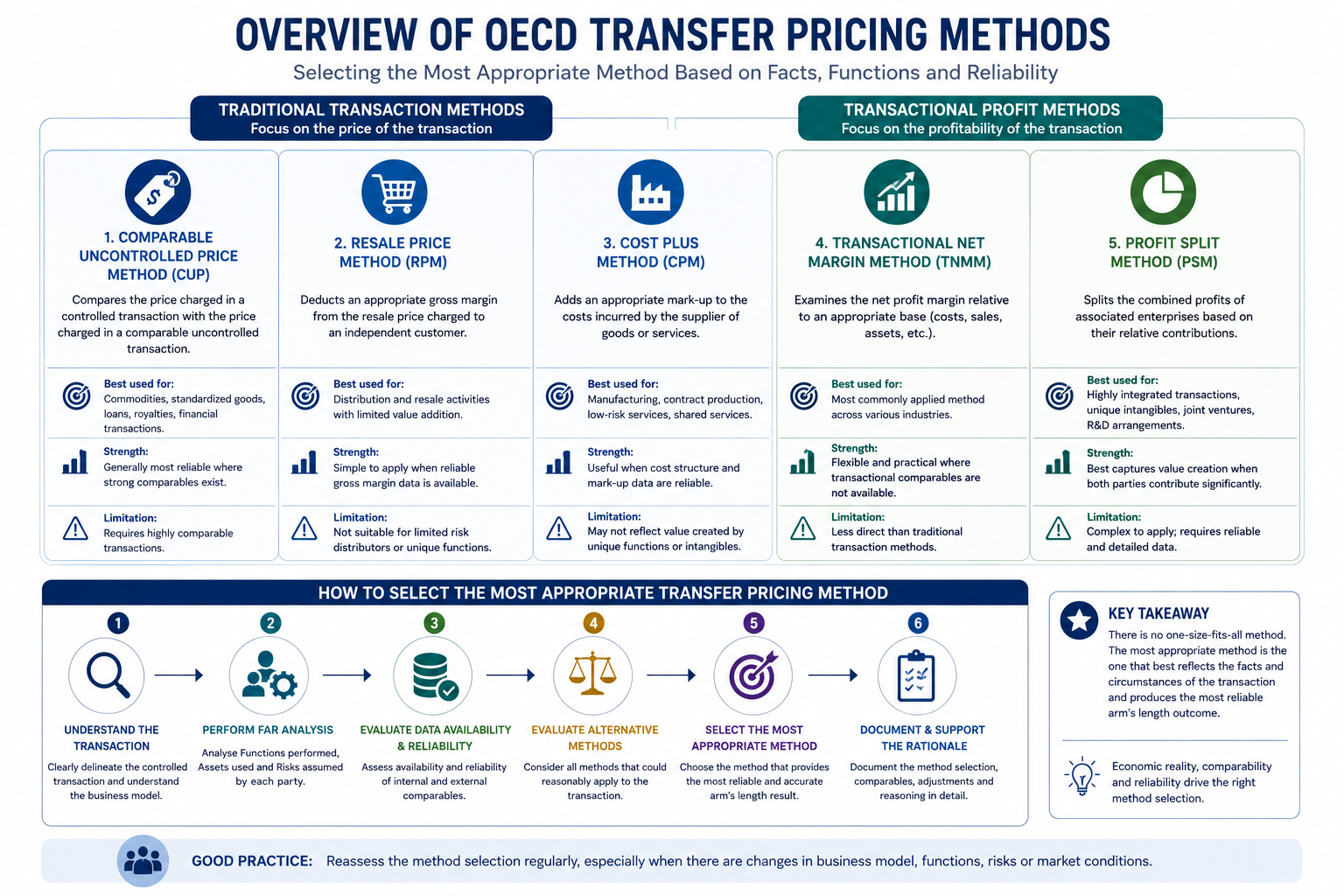
9. Traditional Transaction Methods vs Transactional Profit Methods

The OECD broadly categorizes transfer pricing methods into:

9.1 Traditional Transaction Methods

These focus directly on pricing of transactions. They include:

  • Comparable Uncontrolled Price Method (“CUP”)
  • Resale Price Method (“RPM”)
  • Cost Plus Method (“CPM”)

9.2 Transactional Profit Methods

These focus on profitability outcomes. They include:

  • Transactional Net Margin Method (“TNMM”)
  • Profit Split Method (“PSM”)

10. Comparable Uncontrolled Price Method (CUP)

The CUP Method compares the price charged in a controlled transaction with the price charged in a comparable uncontrolled transaction.

The OECD generally considers CUP highly reliable where:

  • strong comparables exist,
  • products are highly similar,
  • and differences are minimal.

10.1 Common Applications of CUP

CUP is commonly used for:

  • commodities,
  • loans,
  • royalties,
  • financial transactions,
  • and standardized products.

10.2 Challenges with CUP

CUP often becomes difficult where:

  • reliable comparables are unavailable,
  • products differ significantly,
  • or commercial conditions vary materially.

Even small differences may affect pricing reliability.

11. Resale Price Method (RPM)

RPM begins with the resale price to independent customers and subtracts an appropriate gross margin. This method is commonly used for:

  • distributors,
  • resellers,
  • and businesses adding limited value.

11.1 Key OECD Focus Under RPM

Authorities examine:

  • functional comparability,
  • distribution activities,
  • marketing responsibilities,
  • and inventory risks.

Gross margin comparability is critical.

12. Cost Plus Method (CPM)

The Cost Plus Method begins with production or service costs and adds an appropriate mark-up. It is commonly applied where:

  • semi-finished goods are supplied,
  • manufacturing services are provided,
  • or routine support services exist.

12.1 Common Applications of CPM

CPM is frequently used for:

  • contract manufacturing,
  • shared services,
  • low-risk service providers,
  • and intra-group support activities.

13. Transactional Net Margin Method (TNMM)

TNMM examines net profit indicators relative to an appropriate base such as:

  • costs,
  • sales,
  • or assets.

TNMM has become one of the most commonly applied methods globally due to broader availability of comparable company data, and practical flexibility.

13.1 Common Profit Level Indicators (PLIs)

Examples include:

  • Operating Margin
  • Return on Costs
  • Return on Assets
  • Berry Ratio

The selected PLI should align with the transaction and business model.

13.2 Why TNMM Is Commonly Used

TNMM is often selected because:

  • gross margin data may be unavailable,
  • transactional comparables may be limited,
  • and broader comparability may still produce reliable results.

14. Profit Split Method (PSM)

The Profit Split Method allocates combined profits between Related Parties based on their relative contributions.

The OECD generally considers PSM appropriate where:

  • transactions are highly integrated,
  • parties contribute unique intangibles,
  • or both parties make significant value contributions.

14.1 Common Applications of PSM

PSM may apply in:

  • integrated global operations,
  • joint R&D structures,
  • technology groups,
  • financial trading arrangements,
  • and highly interconnected businesses.

15. No Mandatory Hierarchy Under OECD Principles

The OECD Guidelines do not impose a strict legal hierarchy between methods. However, traditional transaction methods are generally preferred where reliable comparables exist, particularly CUP.

Nonetheless, the ultimate objective remains selecting the method producing the most reliable arm’s length result.

16. Internal Comparables vs External Comparables

Tax authorities generally prefer: Internal Comparables

These involve transactions conducted by the taxpayer with independent parties. Where internal comparables are unavailable, businesses often rely on: External Comparables

These are obtained through commercial benchmarking databases.

17. One-Sided vs Two-Sided Analysis

Certain methods focus on one party only:

  • TNMM,
  • RPM,
  • CPM.

Other methods may require analysis of both parties: Profit Split Method.

The complexity of the transaction influences the appropriate analytical approach.

18. Selection of the Tested Party

Under one-sided methods, tax authorities typically analyze: “The Tested Party”

This is usually the entity:

  • performing less complex functions,
  • not owning unique intangibles,
  • and having more reliable comparables available.

Selecting the wrong tested party may significantly weaken the analysis.

19. Reliability Over Mechanical Application

One of the key OECD positions is that transfer pricing method selection should not become a mechanical exercise. Authorities increasingly focus on:

  • economic reliability,
  • commercial substance,
  • and practical accuracy.

A technically perfect method may still be inappropriate if comparables are weak, data is unreliable, or the transaction is misunderstood.

20. Common Tax Authority Concerns

Tax authorities commonly challenge:

  • unsupported method selection,
  • inconsistent group policies,
  • weak comparables,
  • incorrect tested party selection,
  • poor FAR analysis,
  • and inappropriate use of TNMM.

Authorities may also reject benchmarking studies lacking economic substance.

21. Practical Best Practices for Businesses

21.1 Understand the Transaction Properly

Businesses should first accurately delineate:

  • the actual transaction,
  • operational reality,
  • and value chain.

21.2 Perform Strong FAR Analysis

Functional Analysis is critical before selecting a transfer pricing method.

21.3 Evaluate Alternative Methods

Businesses should assess:

  • why the selected method is appropriate,
  • and why alternative methods were rejected.

21.4 Maintain Robust Documentation

Documentation should support:

  • method selection,
  • benchmarking,
  • comparability analysis,
  • and commercial rationale.

22. Transfer Pricing Method Selection and OECD Substance Principles

Modern transfer pricing frameworks increasingly align profits with:

  • value creation,
  • economic substance,
  • and risk control.

Tax authorities increasingly expect method selection to reflect operational conduct, real decision-making, and genuine economic contribution.

23. Frequently Asked Questions (FAQs)

23.1 What is the most appropriate transfer pricing method?

The most appropriate method is the one that provides the most reliable arm’s length outcome considering:

  • transaction characteristics,
  • FAR analysis,
  • comparability,

and data availability.

TNMM is one of the most commonly used methods globally due to practical availability of comparable company data.

Where highly reliable comparables exist, CUP is generally considered highly reliable by the OECD.

TNMM evaluates profitability of one party, while Profit Split allocates combined profits between Related Parties based on value contribution.

Yes. Authorities may reject methods where:

  • comparables are weak,
  • analysis lacks reliability,
  • or the method does not reflect commercial reality.

FAR Analysis helps determine:

  • functional complexity,
  • risk profile,
  • value contribution,
  • and appropriate comparability.

No strict hierarchy exists, although traditional transaction methods are generally preferred where reliable comparables are available.

24. Final Thoughts

Selecting the most appropriate transfer pricing method is one of the most important components of transfer pricing compliance. Modern tax authorities increasingly focus not only on the method itself, but on:

  • economic reliability,
  • comparability quality,
  • substance,
  • value creation,
  • and alignment with actual business conduct.

Businesses should therefore approach transfer pricing method selection as an economic and commercial exercise rather than merely a technical documentation requirement.

A robust and well-supported methodology significantly reduces:

  • audit exposure,
  • disputes,
  • double taxation risks,
  • and transfer pricing adjustments.

25. Disclaimer

The information contained in this article is intended for general informational and educational purposes only and should not be considered legal, tax, accounting, or professional advice. OECD Guidelines and domestic transfer pricing laws may differ between jurisdictions and may evolve over time through legislative amendments, administrative practice, and judicial interpretation.

While every effort has been made to ensure the accuracy and reliability of the information presented, no representation or warranty is made regarding its completeness, accuracy, or applicability to any particular situation. Businesses should seek professional advice tailored to their specific facts and jurisdictions before making transfer pricing decisions.

Reliance on this article without obtaining appropriate professional consultation may expose businesses to tax, compliance, or regulatory risks.

26. How Prime Partners Global Can Assist With Transfer Pricing

At Prime Partners Global, we assist businesses in navigating complex transfer pricing requirements through practical, technically robust, and commercially focused solutions aligned with OECD and international transfer pricing principles.

Our services include:

  • Transfer Pricing Method Selection
  • Benchmarking Studies
  • FAR (Functions, Assets & Risks) Analysis
  • Economic and Comparability Analysis
  • Transfer Pricing Documentation
  • Intercompany Agreement Support
  • Transfer Pricing Health Checks
  • Cross-border Tax Advisory
  • Audit Readiness Support
  • OECD-Aligned Transfer Pricing Advisory

We support multinational groups, family businesses, SMEs, startups, investment structures, and expanding enterprises operating across multiple jurisdictions.

To learn more about our transfer pricing advisory services, connect with us at Click Here.

Leave a Reply

Your email address will not be published. Required fields are marked *

Request Transfer Pricing Consultation