
Functional Analysis in Transfer Pricing: A Practical Guide
Understanding Functions, Assets and Risks (“FAR Analysis”) in Applying the Arm’s Length Principle
1. Introduction
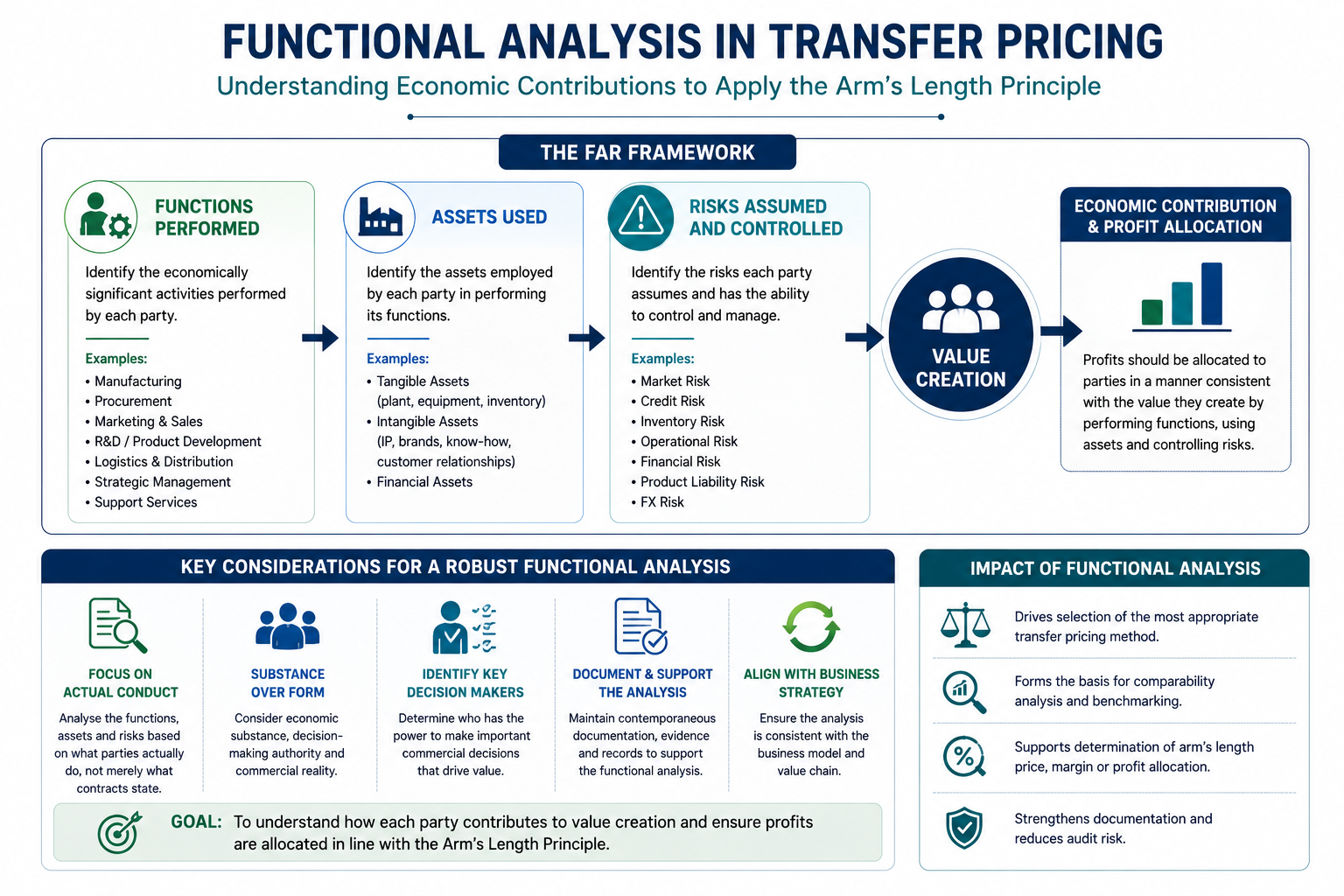
Functional Analysis is one of the most important and heavily scrutinized aspects of transfer pricing globally. Under internationally accepted transfer pricing principles and the OECD Transfer Pricing Guidelines, tax authorities place significant emphasis on understanding the actual economic contributions made by Related Parties or Associated Enterprises.
In practice, many transfer pricing disputes arise not because of the pricing method itself, but because businesses fail to properly identify:
- who performs key functions,
- who controls risks,
- who owns or uses assets,
- and where real economic value is created.
A well-prepared Functional Analysis forms the foundation of:
- comparability analysis,
- method selection,
- pricing determination,
- and transfer pricing documentation.
This article provides a practical explanation of how tax authorities approach Functional Analysis and how businesses can perform an effective FAR Analysis under internationally accepted transfer pricing principles.
2. What Is Functional Analysis in Transfer Pricing?
Functional Analysis refers to the evaluation of:
- Functions performed,
- Assets used,
- and Risks assumed
by each party involved in a related party transaction. This is commonly referred to as: “FAR Analysis”
The objective is to understand:
- the economic roles of each party,
- the value contributed by each entity,
- and the commercial reality of the arrangement.
3. Why Functional Analysis Is Important
Functional Analysis is central to the application of the Arm’s Length Principle because independent enterprises generally earn returns based on:
- the functions they perform,
- the assets they employ,
- and the risks they control and assume.
The OECD Guidelines recognize that entities performing more significant functions and controlling economically important risks would generally expect higher returns.
As a result, Functional Analysis directly influences:
- transfer pricing method selection,
- benchmarking,
- profit allocation,
- and pricing outcomes.
4. Tax Authorities' Focus on Economic Substance
Modern transfer pricing analysis is heavily substance-driven. Tax authorities increasingly focus on:
- actual conduct,
- operational reality,
- decision-making authority,
- and economic substance
rather than relying solely on legal agreements or accounting treatment. The OECD emphasizes that Functional Analysis should reflect what parties actually do, not merely what contracts state.
5. Key Components of Functional Analysis
A proper Functional Analysis generally involves three major areas:
- 5.1 Functions Performed
- 5.2 Assets Used
- 5.3 Risks Assumed and Controlled
Each component plays a critical role in determining arm’s length outcomes.
6. Functions Performed
The first step is identifying the economically significant activities performed by each party. The OECD Guidelines focus on understanding:
- who performs key operational activities,
- who makes strategic decisions,
- and who creates value.
7. Examples of Functions Commonly Reviewed
Tax authorities commonly review functions such as:
- Manufacturing
- Procurement
- Distribution
- Marketing
- Sales activities
- Logistics
- Warehousing
- Customer support
- Product development
- Research & development
- Financing activities
- Treasury management
- Strategic management
- Administrative support
- Human resource management
The importance of each function depends on the nature of the business and industry.
8. Routine vs Non-Routine Functions
Functional Analysis often distinguishes between routine functions, and non-routine or value-creating functions.
8.1 Routine Functions
Routine functions are generally operational or support activities with lower economic complexity. Examples:
- basic distribution,
- contract manufacturing,
- routine support services,
- or low-risk administrative activities.
8.2 Non-Routine Functions
Non-routine functions are typically more economically significant and may involve:
- strategic decision-making,
- unique know-how,
- development of intangibles,
- innovation,
- or high-value management functions.
Entities performing such functions would generally expect higher returns.
9. Assets Used in Functional Analysis
The next step involves evaluating assets employed by each party. This includes both tangible assets, and intangible assets.
10. Tangible Assets
Examples include:
- machinery,
- factories,
- warehouses,
- vehicles,
- equipment,
- and inventory.
The nature, value, and importance of tangible assets may affect expected returns.
11. Intangible Assets
Tax authorities pay particular attention to intangibles because they often drive significant profit allocation disputes. Examples include:
- trademarks,
- patents,
- customer relationships,
- proprietary technology,
- software,
- know-how,
- and brand value.
The OECD strongly focuses on identifying who developed, enhanced, maintained, protected, and exploited the intangible asset. This is commonly known as: “DEMPE Analysis”
12. Risks Assumed and Controlled
Risk analysis has become one of the most important areas in transfer pricing. The OECD Guidelines emphasize that contractual assumption of risk alone is insufficient — actual control over risk is critical.
13. Common Risks Reviewed in FAR Analysis
Authorities commonly evaluate:
- Market risk
- Inventory risk
- Credit risk
- Foreign exchange risk
- Product liability risk
- Operational risk
- Strategic risk
- Financial risk
- Technology risk
The analysis focuses on who controls the risk, who makes decisions, and who has the financial capacity to bear the consequences.
14. Risk Control vs Contractual Allocation
One of the key OECD positions is that risks should be allocated to the entity that:
- exercises control over the risk,
- makes decisions regarding the risk,
- and has the financial ability to assume the risk.
Merely assigning risks through contracts without actual control may not be respected by tax authorities. This area has become a major focus during transfer pricing audits globally.
15. Understanding Value Creation
Modern transfer pricing frameworks strongly focus on “Value Creation”. Functional Analysis helps determine where value is created, who contributes economically significant activities, and how profits should be allocated accordingly.
The OECD increasingly expects alignment between profits, substance, and value-generating activities.
16. Industry-Specific Functional Analysis
Manufacturing Businesses
Authorities may focus on production control, supply chain management, quality control, and inventory risk.Technology Businesses
Focus may include software development, intellectual property, R&D functions, and innovation control.Distribution Businesses
Authorities may evaluate market development, customer relationships, sales strategy, and warehousing activities.17. Functional Analysis and Transfer Pricing Method Selection
Functional Analysis directly affects selection of the most appropriate transfer pricing method. For example:
- routine distributors often use TNMM,
- high-value integrated businesses may require Profit Split,
- straightforward commodity transactions may use CUP.
A weak FAR Analysis may result in inappropriate method selection and transfer pricing risk.
18. Common Functional Analysis Mistakes
Businesses commonly face issues such as:
- Over-reliance on contracts
- Generic descriptions
- Ignoring actual conduct
- Weak risk analysis
- Failure to identify key decision-makers
- Inconsistent documentation
- Unsupported intangible ownership claims
- Incorrect characterization of entities
These issues frequently attract tax authority scrutiny.
19. Practical Steps for Performing a Functional Analysis
19.1 Understand the Business Model
Review operations, value chain, industry, and group structure.
19.2 Conduct Interviews
Discuss operational realities with management, finance teams, operational personnel, and decision-makers.
19.3 Review Supporting Documents
Analyze agreements, policies, emails, board minutes, and operational records.
19.4 Identify Decision-Making Functions
Understand who controls risks, who makes strategic decisions, and who manages key functions.
19.5 Align FAR Analysis With Actual Conduct
Ensure documentation reflects real business operations, not merely contractual wording.
20. Documentation Expectations
A robust Functional Analysis should generally be supported by:
- organizational charts,
- intercompany agreements,
- process flowcharts,
- financial analysis,
- benchmarking studies,
- and operational evidence.
Contemporaneous documentation is strongly recommended.
21. Tax Authorities' Practical Perspective
Tax authorities increasingly perform detailed interviews, operational reviews, and substance testing during transfer pricing audits.
Authorities may compare transfer pricing reports, emails, board approvals, internal communications, and actual employee functions.
Inconsistencies between documentation and reality are often major audit triggers.
22. Frequently Asked Questions (FAQs)
22.1 What is FAR Analysis in transfer pricing?
FAR Analysis refers to evaluating:
- Functions performed,
- Assets used,
- and Risks assumed
by each party in a related party transaction.
22.2 Why is Functional Analysis important?
It helps determine:
- economic contribution,
- value creation,
- transfer pricing method selection,
- and arm’s length profit allocation.
22.3 What is DEMPE Analysis?
DEMPE refers to:
- Development,
- Enhancement,
- Maintenance,
- Protection,
- and Exploitation
of intangible assets.
22.4 Can contracts alone determine risk allocation?
No. Tax authorities generally focus on actual control and decision-making rather than contractual wording alone.
22.5 What risks are commonly reviewed in Functional Analysis?
Common risks include:
- market risk,
- credit risk,
- inventory risk,
- foreign exchange risk,
and operational risk
22.6 Does Functional Analysis affect transfer pricing method selection?
Yes. FAR Analysis is one of the most important factors in determining the most appropriate transfer pricing method.
22.7 What happens if FAR Analysis is weak?
Weak Functional Analysis may result in:
- transfer pricing adjustments,
- audit exposure,
- penalties,
- and unreliable benchmarking results.
23. Final Thoughts
Functional Analysis remains one of the most critical pillars of transfer pricing compliance globally. Modern tax authorities increasingly focus on substance, value creation, decision-making, and actual operational conduct.
A well-prepared FAR Analysis helps businesses:
- apply the Arm’s Length Principle properly,
- support pricing outcomes,
- defend transfer pricing positions,
- and reduce audit exposure.
Businesses should therefore approach Functional Analysis not as a documentation exercise alone, but as a fundamental economic analysis of how value is created within the group.
24. Disclaimer
The information contained in this article is intended for general informational and educational purposes only and should not be considered legal, tax, accounting, or professional advice. OECD Guidelines and domestic transfer pricing regulations may differ between jurisdictions and may evolve over time through legislative amendments, administrative practice, and judicial interpretation.
While every effort has been made to ensure the accuracy and reliability of the information presented, no representation or warranty is made regarding its completeness, accuracy, or applicability to any particular situation. Businesses should seek professional advice tailored to their specific facts and jurisdictions before making transfer pricing decisions.
Reliance on this article without obtaining appropriate professional consultation may expose businesses to tax, compliance, or regulatory risks.
25. How Prime Partners Global Can Assist With Transfer Pricing
At Prime Partners Global, we assist businesses in navigating complex transfer pricing requirements through practical, technically robust, and commercially focused solutions aligned with OECD and international transfer pricing principles.
Our services include:
- FAR (Functions, Assets & Risks) Analysis
- DEMPE Analysis for Intangibles
- Transfer Pricing Documentation
- Benchmarking Studies
- Functional Interviews and Risk Reviews
- Intercompany Agreement Support
- Transfer Pricing Health Checks
- Cross-border Tax Advisory
- Audit Readiness Support
- OECD-Aligned Transfer Pricing Advisory
We support multinational groups, family businesses, SMEs, startups, investment structures, and expanding enterprises operating across multiple jurisdictions.
To learn more about our transfer pricing advisory services, connect with us at Click Here.